
“Anti-slip” can describe two different questions in a marble project: whether a piece moves during installation, and how the finished floor interacts with people walking on it. Adhesive handling and pedestrian slip resistance require different evidence.
Start by identifying what is moving, at which interface and at what stage. A paste retaining its shape, a freshly placed tile resisting downward movement and a shoe contacting a wet marble floor are separate situations.
This guide explains the terminology and shows contractors, distributors and facility teams how to request useful information without transferring one performance claim to another part of the project.
Separate the Claims Before Comparing Products
| Claim or property | What it concerns | Relevant evidence |
|---|---|---|
| Non-sag or non-slump consistency | Shape and flow of the fresh material | Product-specific handling description or defined test |
| Reduced tile slip | Movement of a placed tile in fresh adhesive under specified conditions | Applicable adhesive classification or test report |
| Initial grab or tack | Early resistance to movement at the bonding interface | Defined product claim, application conditions and method |
| Cured bond performance | The developed adhesive connection | Relevant bond test, conditioning and failure information |
| Finished-floor slip resistance | Interaction with the exposed walking surface | Appropriate flooring assessment and test conditions |
Use the exact property name in specifications and inquiries. A request for “anti-slip marble adhesive” leaves the supplier guessing whether the customer needs placement control, bond performance or a different floor finish.
The adhesive beneath a stone tile does not become its exposed walking surface. A well-bonded installation and a floor suitable for its pedestrian use are both important, but they answer different questions.
Understand Non-Sag as a Fresh-Material Property
Shape Retention Helps Application
A non-sag description generally concerns the fresh material’s resistance to flowing or losing shape during the stated application. It can help explain why a paste is suitable for controlled placement at a designated interface.
Read the description alongside mixing, temperature, application depth and working-time instructions. The same phrase may accompany products with very different uses, such as a fabrication paste, a slab-interface adhesive or a tile-setting material.
Choose the product for its actual stone, backing, substrate and application. Shape retention alone does not establish natural-marble floor compatibility. The marble adhesive selection guide explains these material families.
A Standing Ridge Is Not a Contact Result
Material that retains a troweled profile still needs the prescribed embedding process. Inspect effective transfer and bedding contact during trial placement rather than judging the installation by the appearance of undisturbed ridges.
Keep contact observations separate from the amount used. The coverage and consumption guide explains why a high material quantity does not independently establish good contact.
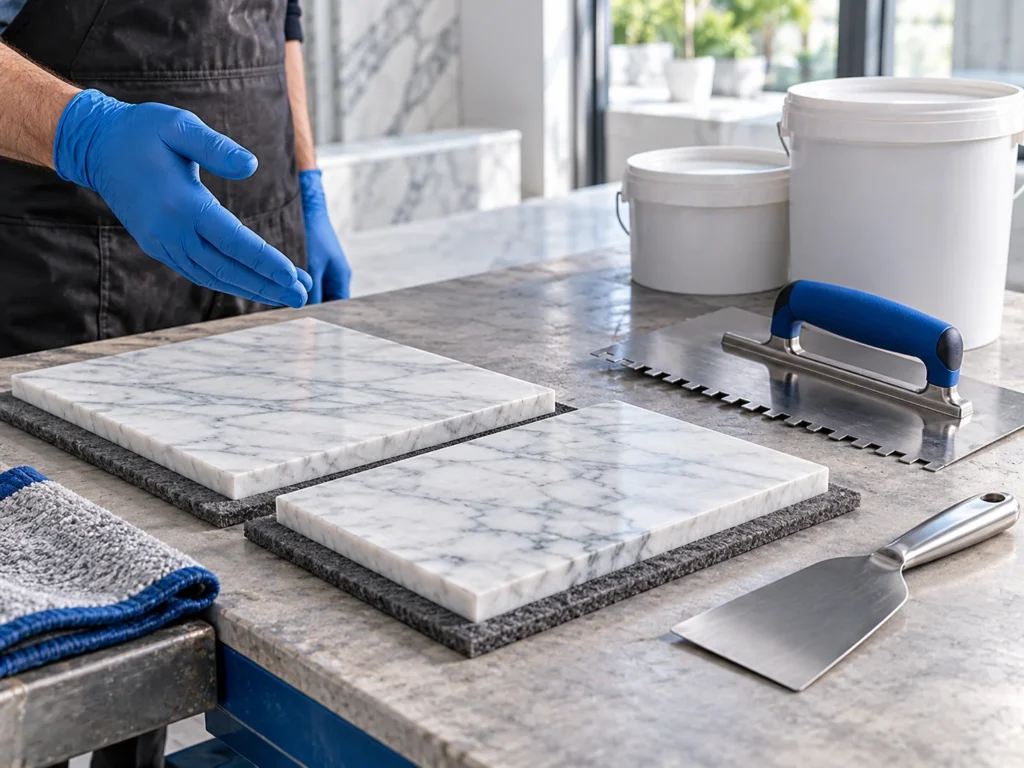
Understand Reduced Slip and Initial Grab During Placement
Read Adhesive Classifications in Their Own Context
Where a product is designated with T under the relevant EN 12004 adhesive classification, the designation concerns reduced slip of the adhesive system under the specified test conditions. It is not a walking-surface friction classification.
Ask which standard, edition and product declaration support the classification. Keep the test tile, substrate, conditions and result with the report where supplied. A classification cannot be assigned to a different product because it looks similar or uses the same resin family.
Other classification elements address other properties. Read the complete declaration and application scope instead of treating one letter as approval for every stone size, surface or installation location.
Early Holding and Cured Strength Are Different Stages
Initial grab describes an early placement behavior. Open time, adjustment time and readiness for loading describe other parts of the process. A piece remaining in position during a short demonstration does not establish the final connection’s load capacity.
For vertical stone or slab work, use the project’s support and fixing arrangement. Determine temporary-support release from the actual materials and system requirements. Do not remove anchors or shorten support periods solely because the paste is described as non-sag or high-grab.
The vertical stone and slab installation guide discusses adhesive interfaces, supports and fixings.
Make a Placement Trial Answer a Placement Question
Use the actual stone, back treatment, receiving surface and selected material. Record the mixing basis, installed depth, tool, working conditions and placement method.
Observe alignment and movement within the intended working process. Inspect representative contact at the appropriate stage. Keep the support arrangement and any adjustments in the record so the trial can be understood later.
Change one significant variable at a time when investigating a problem. Otherwise, a different result may be attributed to the adhesive when the substrate, layer or placement technique also changed.
A hand push, an unsupported hanging sample or an improvised added weight is not a substitute for a specified bond test. Where load performance needs verification, define the method, conditioning and acceptance criteria. The stone adhesive testing guide explains the necessary evidence.
Assess the Marble Walking Surface Separately
Identify the Exact Finish and Use
For pedestrian slip resistance, start with the exposed stone surface and the intended location. Record the finish, installed condition, expected wetting or contamination, footwear or barefoot use, slope and maintenance process.
An entrance exposed to tracked-in rainwater presents a different use from a normally dry interior display area. Similarly, a dry sample result does not describe every wet or contaminated condition.
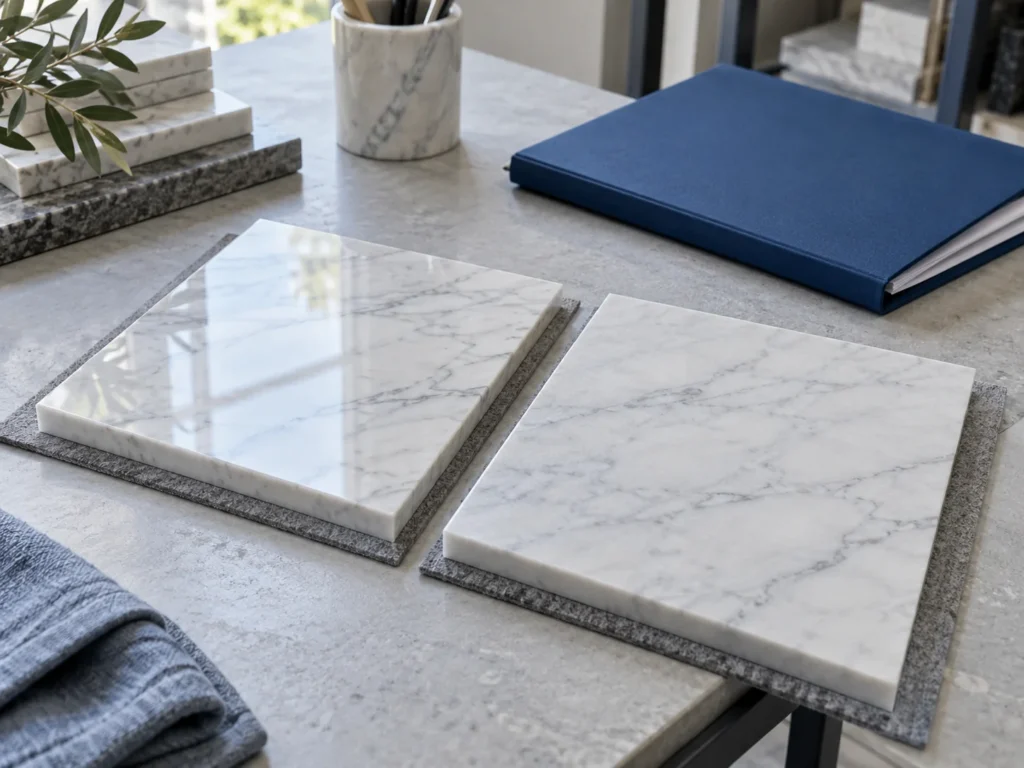
Terms such as polished, honed, textured or sealed help identify the specimen. They are not complete test results. Compare evidence for the actual finish and treatment rather than assigning a performance ranking from appearance alone.
Keep Surface Conditions in the Assessment
Water, cleaning residues, dust, oil and other contaminants can alter the interaction at the walking surface. Identify likely sources and how the site will control them.
Include drainage, cleaning access and transitions in the discussion where relevant. A product result is one input to material selection and site management; it does not describe every person’s movement or every future condition.
A strong cured bond beneath the tile is not evidence that the finished marble has suitable surface friction. Conversely, a floor-surface test does not establish the bond beneath it.
Request Comparable Floor-Test Information
A report becomes useful when its specimen and conditions match the question being asked. Request the following fields before putting two results in the same comparison.
| Report field | What to identify | Comparison question |
|---|---|---|
| Surface specimen | Stone, finish, treatment and condition | Is this the same exposed surface being proposed? |
| Method | Named procedure and edition | Were the results produced by a comparable method? |
| Contact and contamination | Slider or contact material, dry/wet state and test medium | Does the condition relate to the intended use? |
| Sampling | Locations, directions and preparation | Does the assessment represent the relevant floor areas? |
| Result and interpretation | Units, classification and stated scope | What does the reported value actually support? |
| Traceability | Date, laboratory or operator and sample identity | Can the result be linked to the supplied or installed finish? |
DCOF means dynamic coefficient of friction. It is a measurement under defined conditions, not a universal prediction that a person will or will not slip. Its interpretation belongs with the method, intended application and other relevant factors.
Pendulum and ramp-based methods investigate surface interaction through different procedures. Their values or classes should not be substituted for one another without an appropriate technical basis. Static and dynamic friction figures also answer different measurement questions.
Have a competent testing provider select and apply the procedure for the project question. A casual walking trial or touching the surface by hand does not produce an equivalent result.
Include Cleaning and Finishing in the Floor Plan
Control Contamination and the Cleaning Sequence
Agree how spills and tracked-in material will be addressed, who owns the response and how cleaning areas will be managed. The process should suit the marble, residue and expected traffic.
Use the correct cleaning product and dosage, with maintained equipment. Plan drying or access control after wet cleaning rather than assuming the floor is ready because visible soil has been removed.
Record changes in cleaner, machine, pad or method. If a concern appears after maintenance, those details help separate residual contamination from a change in the stone finish or treatment.
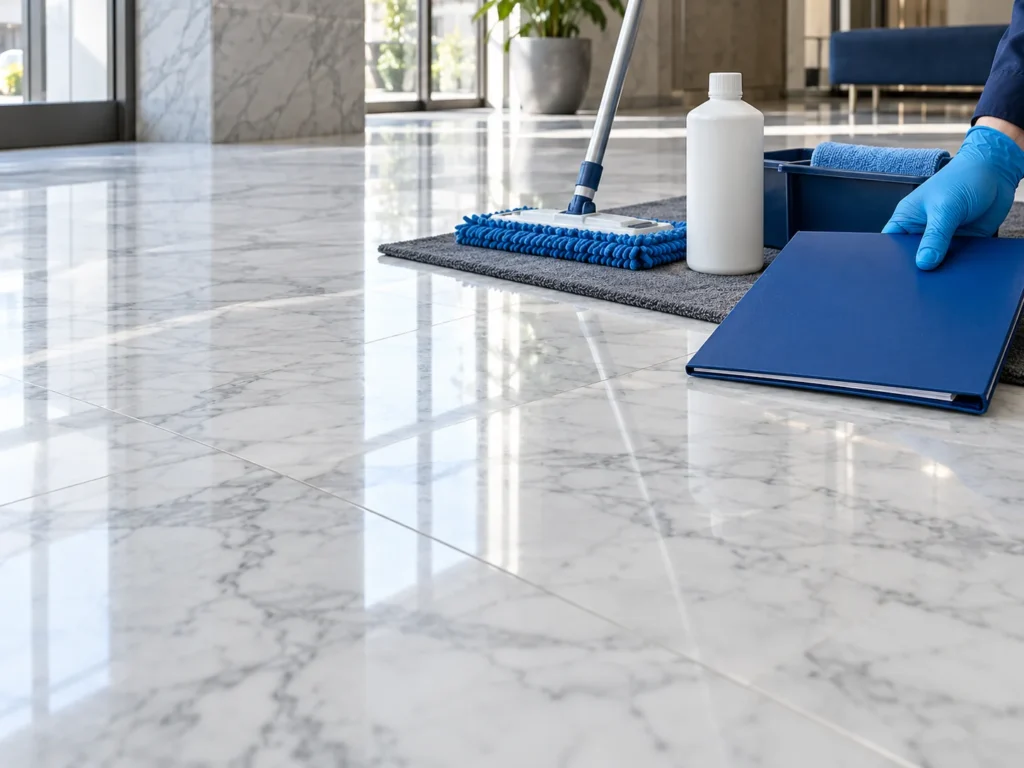
Treat Gloss and Slip Performance as Different Outcomes
A gloss-enhancing treatment is selected for an appearance objective. Assess any proposed wax, crystallization process or coating with its actual finish and use in mind.
Retain product identification and the treatment history with the floor records. Review whether the resulting surface needs further assessment after a material or maintenance change. A photograph of increased shine cannot establish the resulting floor’s slip behavior.
KEDA SC500 Marble Crystallizer & Polish and Stone Polishing Wax concern specified gloss or finishing work. Their appearance descriptions do not establish improved pedestrian slip resistance, and they should not be presented as general anti-slip treatments.
Turn the Customer’s Wording Into a Defined Requirement
| Customer statement | Clarify the actual problem | Useful next step |
|---|---|---|
| “The marble slides during setting” | Piece movement, fresh material, conditions and support | Review the placement method and relevant adhesive data |
| “I need a non-sag glue for a panel” | Panel, interface, geometry and fixing arrangement | Review material scope and the complete installation system |
| “The floor feels slippery after cleaning” | Location, wetness, cleaner, residue and finish | Review maintenance and arrange relevant surface assessment |
| “This result proves the floor is safe” | Test method, specimen and application scope | Interpret the report with site conditions |
| “A stronger adhesive will solve the problem” | Whether the concern is bonding, placement or surface interaction | Select evidence for the identified interface |
Keep separate acceptance criteria where a project has both vertical installation and pedestrian-floor requirements. One broad “anti-slip” line in the quotation cannot define both jobs.
Keep a Short, Traceable Handover Record
Retain the adhesive identification, installation method, material batches and relevant placement observations. Store the specified bond-performance evidence with the installation records.
For the exposed floor, retain stone and finish identification, surface treatments, applicable assessment reports and the cleaning plan. Record the dates and areas of later maintenance changes.
If a concern develops, describe its location, conditions and timing before proposing a product substitution. Use those observations to decide whether the next investigation concerns the bond, the fresh-material process or the walking surface.
The marble tile installation guide provides the wider placement and handover sequence.
Discuss the Application With KEDA
For an adhesive inquiry, send the stone dimensions, back photographs, substrate, orientation and proposed support arrangement. State whether the requirement concerns application consistency, reduced tile movement or a defined cured-bond property.
For a stone-care inquiry, describe the exposed finish, existing treatments and desired appearance. Explore the KEDA product range and contact KEDA with those details. Keep any finished-floor slip-resistance requirement explicit and supported by the relevant assessment.
Frequently Asked Questions
1. Does non-sag marble adhesive make the finished floor less slippery?
Non-sag describes fresh-material behavior at the bonding application. Pedestrian slip resistance concerns the exposed walking surface and its conditions. Evaluate the two properties separately.
2. Does a T adhesive classification describe floor traction?
In the relevant EN 12004 adhesive classification, T concerns reduced tile slip under the specified test. It is not a DCOF value or a finished-floor pedestrian classification.
3. Can high initial grab replace panel fixings or temporary support?
Use the actual installation system’s fixing and support requirements. Early holding behavior does not independently establish the final load capacity or the point at which supports can be removed.
4. Can I compare DCOF, pendulum and ramp results directly?
Identify the procedure, contact material, test condition and interpretation first. Different methods produce different measurements or classifications; do not treat their outputs as interchangeable scores.
5. Do polishing wax or crystallization products guarantee anti-slip performance?
Their gloss or finishing purpose does not establish that outcome. Review the actual treated surface, intended use and relevant assessment rather than inferring slip performance from appearance.