
A distributor can build a range around a manufacturer’s brand, a customer-owned brand or a combination of the two. The workable route depends on the selected product line and the actual supply arrangement.
For KEDA, begin by separating core stone adhesives from complementary product lines. Then confirm the product, quantity and packaging before treating a design proposal as an order ready for production.
This guide explains KEDA’s published cooperation routes and gives buyers a practical approval sequence. It focuses on brand and packaging decisions rather than forecasting a first order or promising a universal customization service.
1. Confirm the Brand Route for Each Product Line
KEDA’s distributor and partner program keeps its three core adhesive ranges under the KEDA brand. Customer-brand discussions apply to other product lines, subject to the selected item and applicable order requirements.
Use a line-by-line list for a mixed range. A branding arrangement agreed for one item should not silently become the instruction for every product in the shipment.
| Product line | Published cooperation route | What to confirm for the order |
|---|---|---|
| مواد لاصقة للرخام | KEDA brand | Grade, color, capacity, components and quantity |
| Epoxy structural adhesives | KEDA brand | Supplied grade, matched components and packaging |
| Epoxy slab adhesives | KEDA brand | Selected interior-installation product and order configuration |
| Complementary product lines | Customer-brand discussion available for eligible items | Exact product, applicable MOQ, label and packing scope |
The table describes a commercial route, not product suitability or an exclusive distribution agreement. Technical selection, supply details and any territory arrangement remain separate decisions.
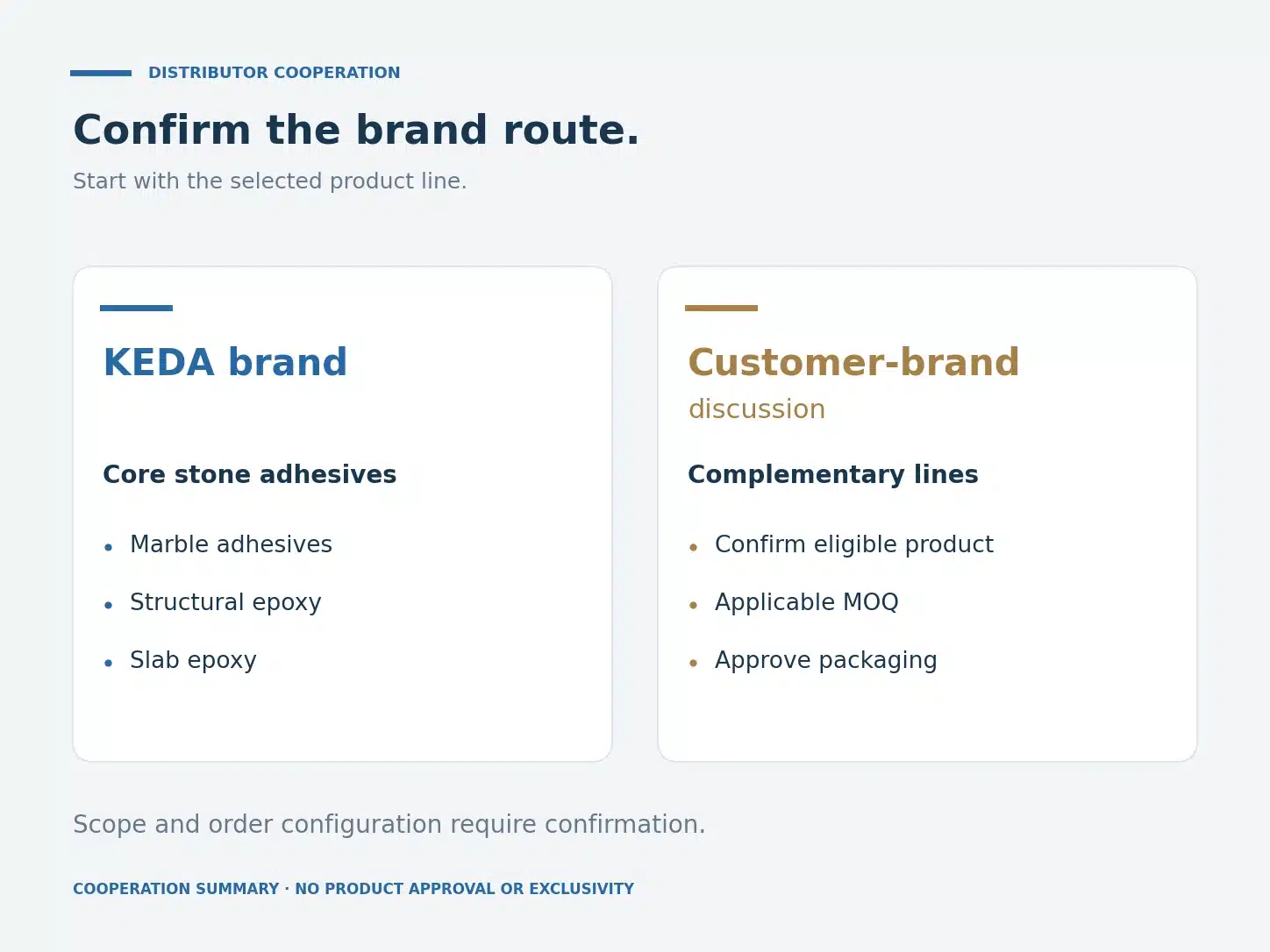
Cooperation-scope summary; not actual packaging artwork, product approval or an exclusivity commitment.
Keep the agreed route in the quotation and order record. That gives the buyer, designer and supplier the same starting point before artwork is prepared.
2. Build the Core Range Around Its Actual Applications
KEDA’s marble adhesive range addresses stone fabrication, filling and local repair. Identify the grade and intended customer application before deciding which colors and capacities belong in the distribution range.
For لاصق هيكلي إيبوكسي ثنائي المكونات, collect the stone, support material and specified installation requirements. A commercial brand decision does not establish an installation design or authorize a claim about replacing fixings.
لاصق إيبوكسي للألواح ذو رائحة خفيفة serves a separate indoor slab and panel-installation discussion. Keep its product identity distinct from structural epoxy when preparing sales materials and order descriptions.
For these lines, ask how the confirmed KEDA product information and available visuals should be used in your catalogue or website. Preserve product names and application distinctions instead of turning several products into one general-purpose glue listing.
A buyer may still need an internal stock code or catalogue reference. Map that reference to the exact supplier item and packaging so a sales shorthand does not obscure what will be supplied.
3. Define the Scope of a Customer-Brand Enquiry
For complementary items, start with the exact product and task. KEDA’s construction adhesive options provide one example of a product family to discuss; the family name alone does not confirm every proposed private-label configuration.
List the intended substrates, application, destination, required pack format and estimated quantity. Identify whether the request concerns a label on an existing package, an outer carton or another proposed packaging change.
KEDA’s published arrangements describe customer labels and design assistance for eligible products after the applicable minimum quantity is met. Confirm what that means for the specific item before investing in a complete artwork set.
Do not treat a customer-brand request as a formulation-development agreement. If you need a particular performance level, color, chemistry or application scope, ask whether an appropriate supplied product exists and what evidence is available.
Separate the commercial name you want from the claims the product can support. A stronger-sounding label cannot establish movement capability, stone compatibility or another unverified property.
4. Separate Product Evaluation From Packaging Approval
Evaluate the selected product for the customer’s actual application. Identify the sample and record the task, materials, preparation and agreed outcome. Keep any packaging mockup clearly associated with that product identity.
KEDA offers samples with shipping paid by the customer. Confirm the products, destination and shipment arrangement for the proposed evaluation; an initial sample request does not define every later commercial specification.
A successful product trial and an attractive label answer different questions. Product evaluation concerns suitability for the defined task. Packaging approval concerns what the agreed item will look like, contain and communicate.
If the sample uses a different pack format from the proposed order, record that difference. Ask which aspects of the sample represent production supply and which remain to be confirmed.
Keep changes visible. A revised grade, component configuration or pack size should trigger a review of the corresponding description and artwork rather than being treated as an invisible purchasing adjustment.
5. Prepare a Controlled Label and Artwork Brief
KEDA’s standard packaging is English by default. For another language or an eligible customer-brand presentation, define the requested content and review responsibilities before printing.
Work from the actual supplied product information. The brand owner, buyer and supplier need a clear way to identify who supplies each item of text, who checks it and which version is approved.
| Artwork item | Information to establish | Approval record to retain |
|---|---|---|
| Product identity | Exact grade, variant and approved name | Link between the supplier item and artwork |
| Brand elements | Agreed brand route and authorized assets | Accepted logo/text files and placement |
| Contents and components | Net-content declaration and component identification | Confirmed package information for each item |
| Application wording | Intended scope and supported statements | Source for the accepted description |
| Instructions and safety information | Actual product documents and destination review needs | Responsibility and accepted content version |
| Languages and contact details | Requested translations and relevant parties | Reviewed text and spelling confirmation |
| Production artwork | File version, dimensions and final layout | Dated approval tied to the exact file |
This is an approval checklist, not a universal label template or a determination of destination-market requirements. Identify the requirements for the actual product and market separately.
Use one current master file and a simple version reference such as PK-01. Save the approved file with the order instead of relying on an image copied from a chat thread.
Where translations are needed, keep the source wording and reviewed translation together. A layout change should not accidentally remove a qualification or disconnect an instruction from the correct component.
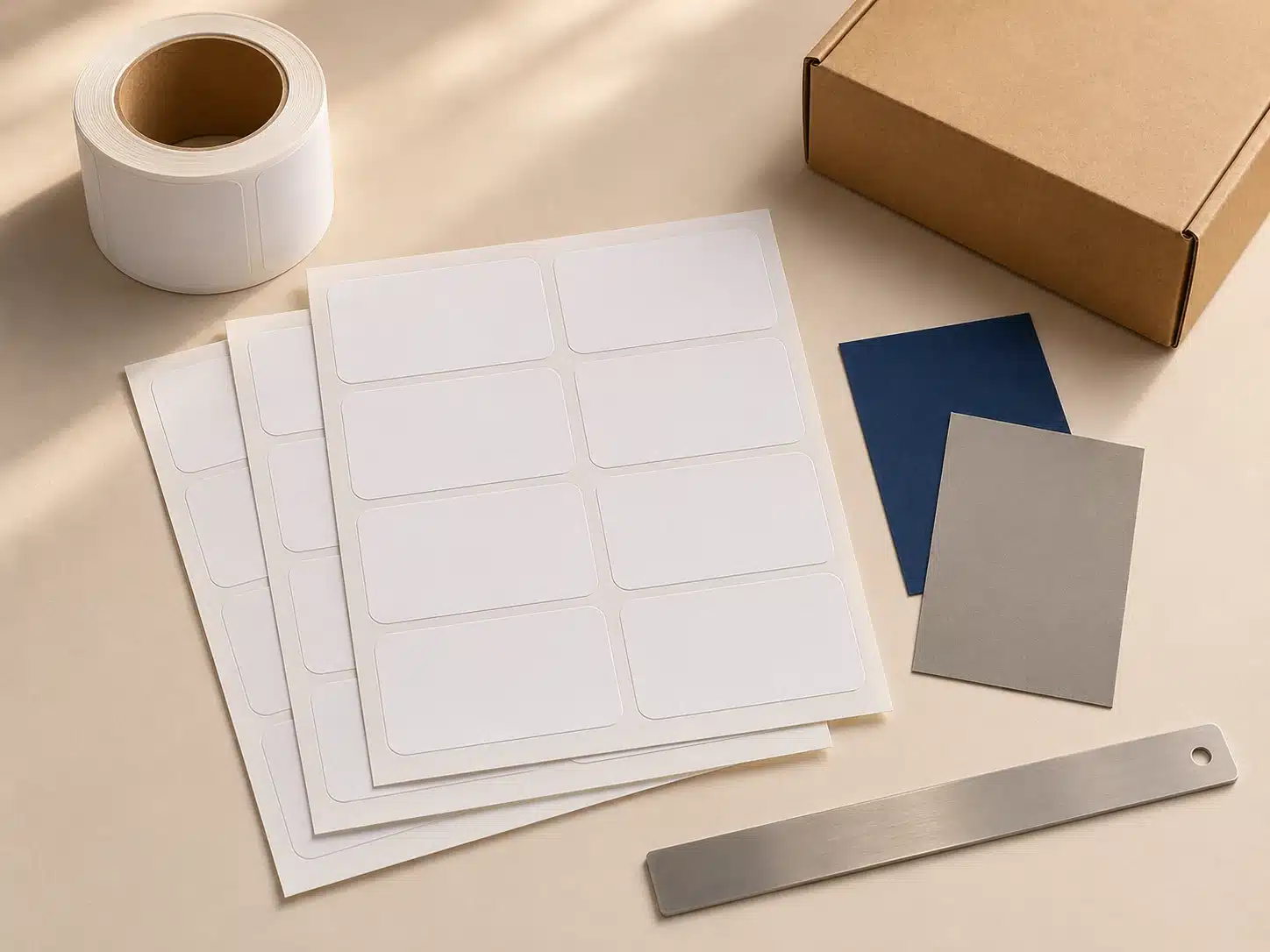
Generic design references; not an approved chemical label or actual KEDA artwork.
6. Confirm the Physical Pack, Not Just the Front Label
A packaging proposal should identify the container, component arrangement and outer packing as well as its appearance. A front-label rendering cannot show everything the warehouse and customer will receive.
For a multi-component item, confirm how the components are identified and supplied. Check the description of a complete purchase unit so the order does not confuse one container with a complete set.
Record units per carton, relevant dimensions, gross weight and any agreed handling or packing information when available. Mark estimates as estimates until the actual configuration is confirmed.
Review the relationship between label and container. Confirm the proposed label size, placement and version against the selected package, rather than assuming a proof for one capacity fits another.
Keep decorative mockups separate from production proofs. A digital presentation can help choose a direction, while the final file and physical configuration still need review against the order.
For shipment planning, obtain the actual supplied product’s transport and packing information. Neither an unmarked carton photograph nor a product-family name establishes a shipping classification or accepted transport method.
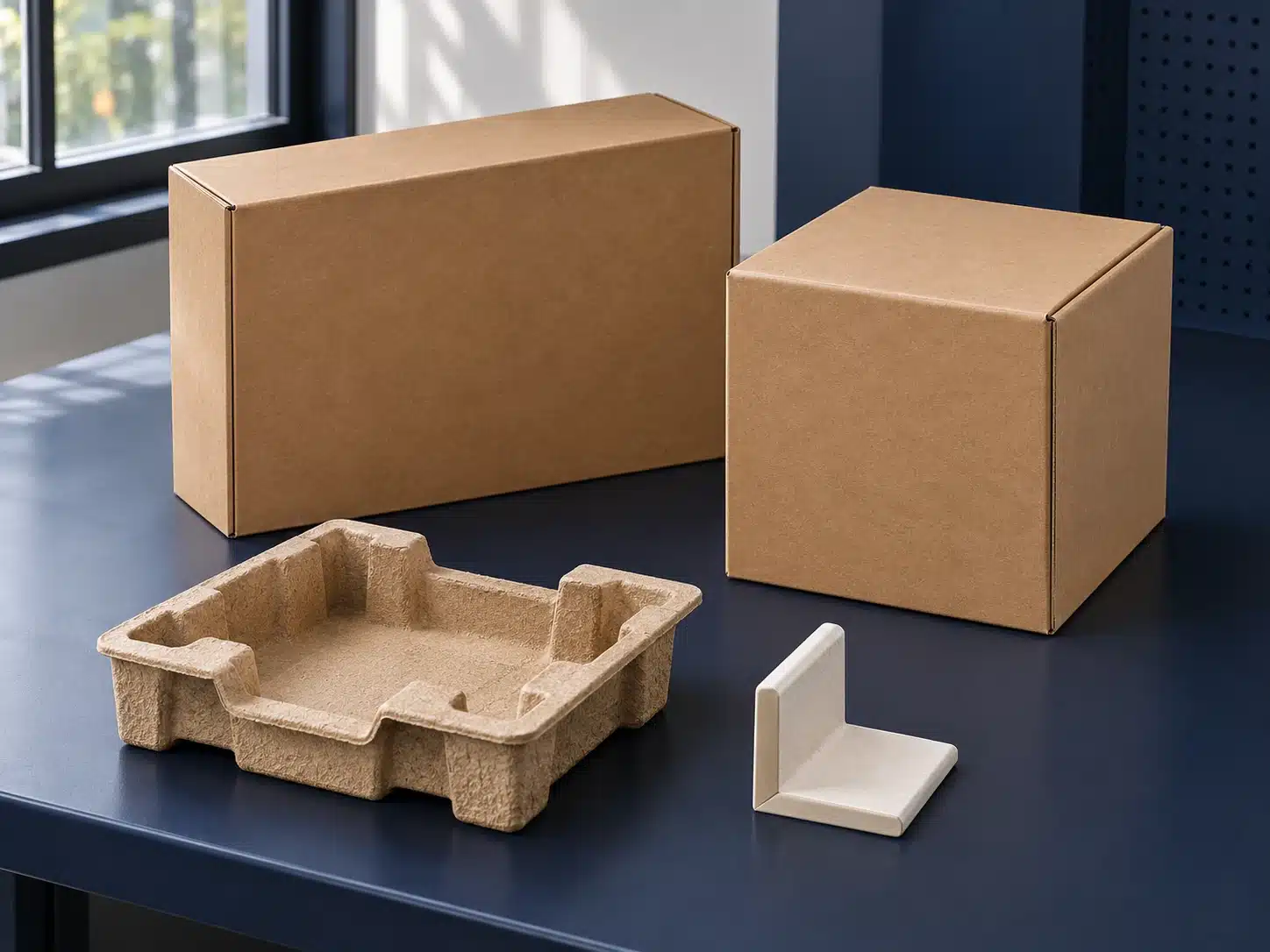
Packing-format discussion only; no chemical transport classification, shipping approval or actual shipment is depicted.
7. Agree Quantity, Schedule and Delivery as Separate Items
Ask for the applicable minimum quantity at the level that matters to the proposed configuration. Clarify whether a condition applies to a product, pack size, color, label version or another agreed unit; do not divide one total across variants without confirmation.
For a mixed order, preserve each line’s brand route and packaging conditions. Combining items for discussion does not make their quantities, artwork or technical requirements identical.
KEDA publishes a typical order lead time of 15–30 days. Confirm the actual schedule for the selected products and packaging, including what needs to be approved before the supplier can commit to it.
Keep the production schedule separate from transit and arrival planning. A buyer’s required warehouse date should be stated explicitly, so the conversation covers the stages needed to reach that date.
If artwork or a product choice changes, ask what the change does to the agreed schedule. Record the revised commitment rather than keeping an outdated date in a different document.
Delivery arrangements and the quoted cost boundary also need agreement. List what is included, what remains an estimate and what information is still needed for the shipment proposal.
8. Release the Order From One Consistent Record
Before production release, reconcile the product list, commercial proposal, component configuration and approved artwork. The same item should have the same identity across those records.
Use a short status list to make unresolved items visible. “Artwork sent” is different from “artwork approved,” just as “sample received” is different from “evaluation accepted for the defined task.”
| Decision stage | Evidence that should be available | If the item is unresolved |
|---|---|---|
| اختيار المنتج | Exact item, intended application and relevant evaluation | Continue the product review |
| Brand scope | Agreed route for each order line | Confirm the route before artwork release |
| Pack and quantity | Components, capacity, packing and applicable MOQ | Revise or clarify the configuration |
| Artwork | Approved version tied to the correct item | Keep printing pending |
| Schedule and delivery | Current agreed dates and shipment scope | Obtain the missing commitment |
| Final release | Consistent order record and responsible approval | Close the specific open item first |
This is a buyer’s coordination aid, not KEDA’s internal production procedure. Agree the actual release process with the supplier and preserve changes in the order file.
Where several people are involved, name one person to maintain the current record. A designer’s approval of color should not be confused with the technical review of product wording or the purchasing approval of quantity.
9. Keep the Approved Information Consistent After Delivery
The distributor’s website, catalogue, sales sheets and staff briefing should describe the product actually received. Check that images, names, component information and application statements match the agreed supply.
A product photograph can support identification, but it is not performance evidence. Keep the relevant technical information accessible to the sales team so customers receive a recommendation based on their application.
When reordering, reference the approved item and artwork version. Identify any requested changes explicitly, including revised language, contact details, colors or packaging.
Record feedback about the physical pack and the customer’s use separately. A damaged carton, unclear label and application problem may need different follow-up information.
When discussing your brand and packaging plan with KEDA, send the product list, destination, quantity by variant and requested packaging scope. Include the decision you need next: a product recommendation, MOQ confirmation, artwork review or an order schedule.
The goal is a reviewable supply arrangement: the right product, an agreed brand route, a confirmed pack and one approved information set carried through to the customer.
الأسئلة الشائعة
1. Can I put my own brand on every KEDA product?
No. The published program distinguishes core adhesives from eligible complementary lines. Confirm the route for each item before preparing customer-brand artwork.
2. Can a mixed order use different brand arrangements?
Discuss the proposed mix line by line. Each item keeps its agreed product, quantity and packaging conditions; combining lines does not erase those distinctions.
3. Is there one private-label MOQ for the entire range?
No universal figure is given here. Request the applicable quantity for the exact product and packaging configuration, including any variants.
4. Does label approval confirm the product’s performance claims?
No. Product scope and supporting information need their own review. Artwork approval does not create a technical rating or application approval.
5. Does the typical order lead time include shipping to my warehouse?
Treat order lead time and transit as separate planning items. Confirm the actual production and delivery schedule for the proposed order and destination.