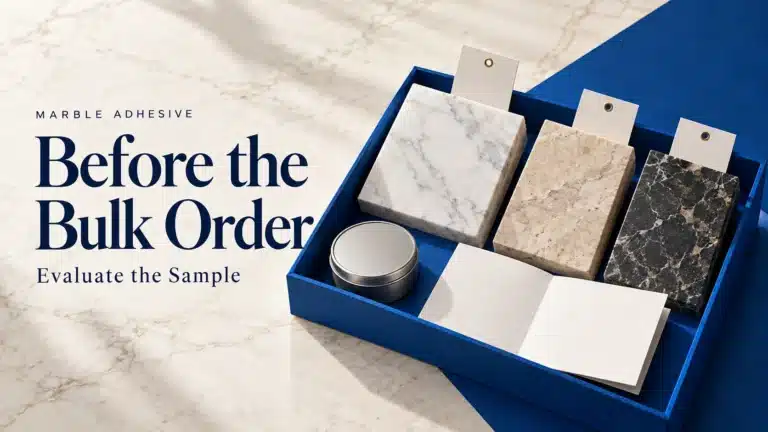

A practical first order of marble adhesive starts with the work your customers already do: which stone they process, how they match visible joints, how much adhesive they use, and which pack sizes they will reorder. Those answers are more useful than stocking every available combination.
Build your opening range around repeat demand, add a limited trial range for uncertain requests, and keep uncommon combinations available by inquiry. This approach gives sales staff a clear offer while reducing money tied up in slow stock.
This guide explains how to select base colors, compare pack sizes and turn customer information into an order list. It covers polyester marble adhesive for nonstructural fabrication and local repair. Structural anchoring, flexible joints and other bonding systems require a separate selection.
Start with Customer Demand, Not the Full Catalog
Record the work behind each inquiry
Ask customers about their stone, their operation and their consumption. A repair business buying occasionally has different packaging needs from a fabrication workshop using the same color throughout its production schedule.
Use recent orders and direct customer conversations to record:
- Stone names, suppliers and representative offcuts.
- Typical work: local filling, edge assembly or visible joints.
- Current adhesive family, base color and pack size.
- Consumption in a defined period, including whether it is measured or estimated.
- Preferred purchasing frequency and recurring problems.
Separate confirmed repeat purchases from requests for quotations. A contractor asking about a large project has not yet established regular demand. Keep the opportunity visible, but identify its expected order date and approval status before allocating stock.
Build three stock groups
Core stock serves repeat buyers using an approved combination. Trial stock supports a limited evaluation with a named customer and a review date. Order-on-request items cover uncommon combinations that do not yet justify routine stock.
These groups are purchasing decisions, not permanent labels. Move an item into core stock when repeat orders and customer approval support it. Reduce its allocation when demand disappears, even if the color remains prominent in your catalog.
Choose Base Colors from Finished Joint Samples
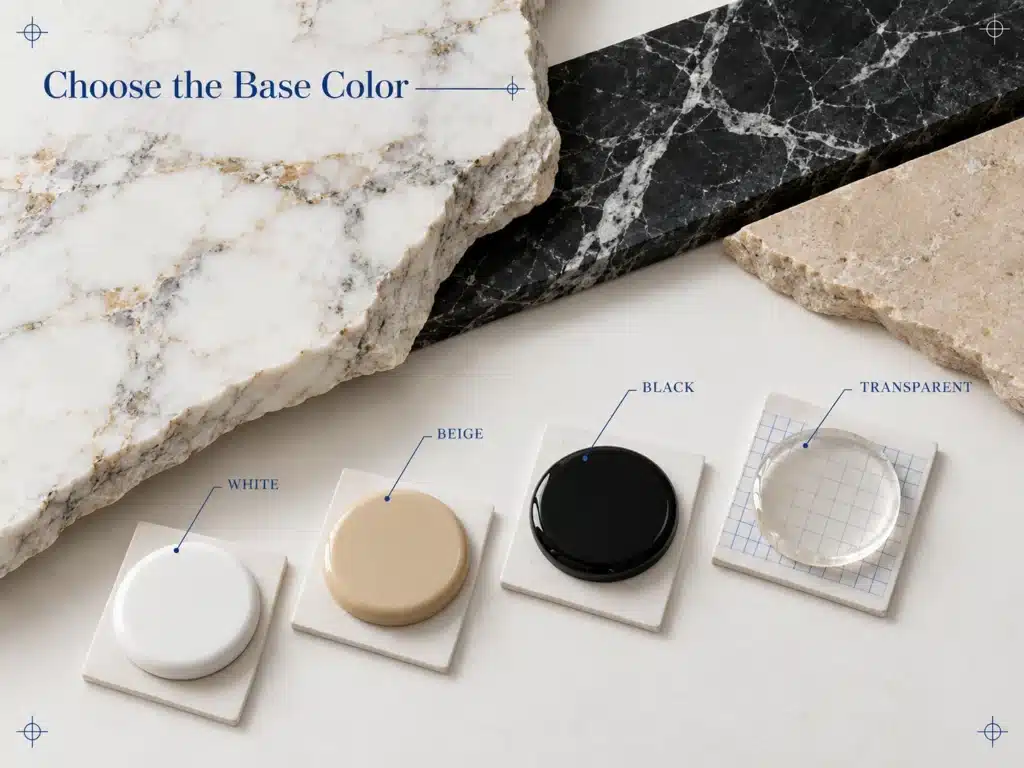
The KEDA Knife Grade Polyester Marble Adhesive range lists Black, White, Beige and Transparent, with matched hardener supplied. Use those names to identify the starting material; approve the appearance on the customer’s actual stone.
Match the visible joint area
An offcut showing the whole slab may be a poor reference for a narrow seam crossing a particular vein. Ask where the adhesive will remain visible, then reproduce that detail with representative stone, joint geometry and finishing.
Compare the cured and finished sample under lighting relevant to the customer’s work. Retain its identity and recipe so a later order can be compared with the approved reference. A phone photograph helps communication, but screen settings and lighting can change the apparent shade.
| Base color | Useful selection question | Approval check before stocking |
|---|---|---|
| White | Do customers repeatedly request a light base for their stone details? | Inspect the finished joint, including visible contrast and any surrounding color change. |
| Beige | Are recurring customers working with warm-toned stone or approved beige matches? | Compare against the actual joint area; beige stone names cover many different tones. |
| Black | Is there repeat demand for an approved dark joint or fill? | Review contrast at edges, veins and any lighter areas bordering the repair. |
| Transparent | Does the workshop need a tintable base for a documented matching process? | Check the actual cured appearance and approved tint recipe; transparent does not mean invisible. |
The table provides selection questions, not a rule assigning one adhesive color to every stone of a particular color.
Separate color matching from staining checks
A joint can have an acceptable shade while the surrounding stone develops an unwanted mark. Include a separate inspection of the adjacent surface, especially on light, porous or translucent material. Review the guide to adhesive staining and glue lines when planning these checks.
Record the adhesive grade, base color, hardener, tint, quantities, stone and finishing method. If a customer changes the slab source or surface treatment, review the sample again rather than relying only on the previous stone name.
Use Color Paste to Support a Manageable Range
Compatible Stone Adhesive Color Paste can help workshops adjust an approved base. Stock tint shades according to recipes customers actually use, rather than purchasing equal quantities of every available shade.
Ask KEDA to confirm compatibility, the permitted addition amount and the mixing sequence for the selected adhesive. Color paste is a coloring accessory; the adhesive still needs its specified matching hardener.
A useful customer reference records the base, tint identity, measured quantity, component ratio, sample ID and finished appearance. For the workshop procedure, see color matching for marble joints and repairs.
Tinting also creates a service requirement. A distributor offering a matching range should be able to identify the recipe used and explain the approved process. Where customers want a ready-to-use base with minimal adjustment, evaluate that preference before replacing several approved base colors with transparent stock and a tint kit.
Compare Pack Sizes Against Consumption
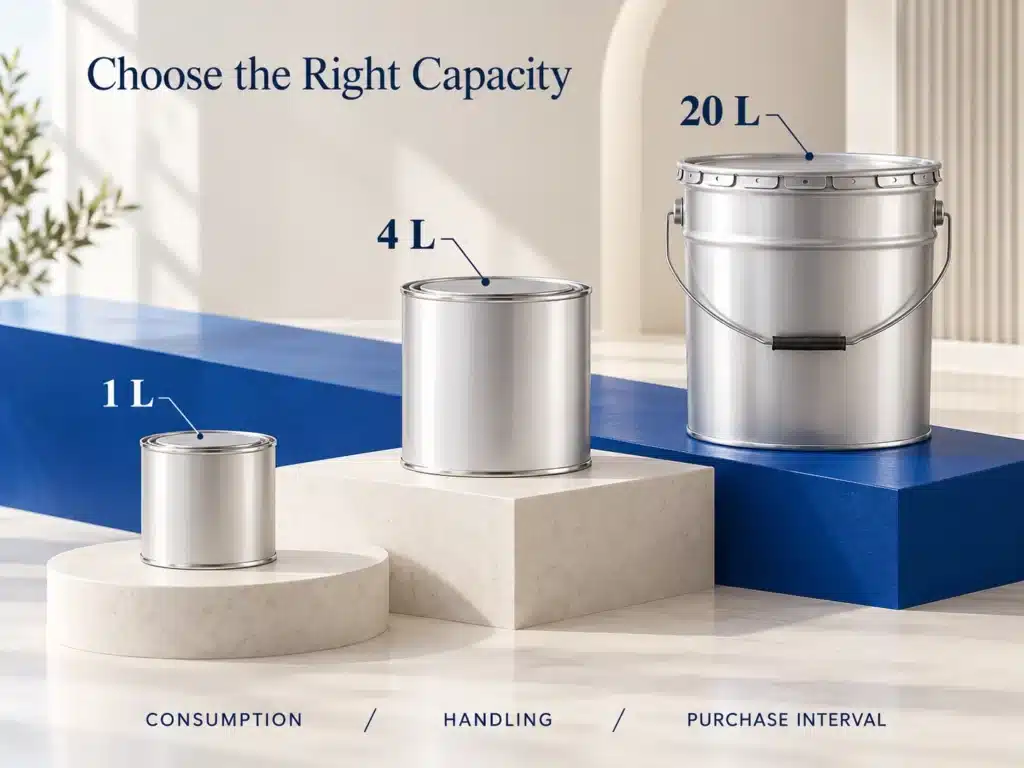
KEDA lists 1 L, 4 L and 20 L capacities. Choose among them using actual customer consumption, handling and purchasing patterns. Confirm the packing arrangement and order quantity for each selected color and capacity in the quotation.
A larger container does not establish better value by itself. Compare purchase price, shipping allocation, local handling, saleable demand and the quantity customers can use under the supplied storage instructions.
| Pack size | Candidate customer pattern to investigate | Question that decides the choice |
|---|---|---|
| 1 L | Occasional repairs, smaller workshops or a controlled introduction | Does this quantity match the customer’s usage and desired purchase interval? |
| 4 L | Recurring workshop use that exceeds occasional small-pack demand | Does the workshop consume it consistently without excessive remaining opened material? |
| 20 L | Established production demand for the selected grade and color | Are consumption, dispensing, storage and handling suitable for this container? |
These are planning examples, not mandatory customer categories or guaranteed consumption rates.
Separate sell-through from workshop consumption
Your distributor warehouse sells sealed packs; the workshop opens and consumes them. Record both. A shop may buy one large container less frequently while using adhesive regularly. Another may place frequent small orders because several technicians need separate containers.
Keep the matched hardener configuration attached to each adhesive order line. Confirm what is supplied, how components are identified and how replacement hardener inquiries will be handled. Do not assume that one hardener tube serves every capacity or that an unrelated hardener is interchangeable.
Keep units clear
When comparing orders, distinguish containers, cartons, liters and kilograms. A capacity in liters does not establish net weight in kilograms. Use the supplier’s confirmed packing and weight information for transport calculations.
For example, three 4 L containers represent 12 L of listed capacity. They do not automatically represent 12 kg of adhesive, and the calculation says nothing about carton quantity or shipping weight.
Build the First Order One SKU at a Time
For stock planning, treat each confirmed grade, base color and capacity combination as a separate SKU. Four colors across three capacities create twelve possible combinations before accessories are considered. That arithmetic describes range complexity, not a recommendation to buy all twelve.
Start with the combinations linked to named customers. Add a trial quantity only when someone owns the evaluation and a follow-up date is recorded. A sample still awaiting approval belongs in the trial group, even if its likely order volume is attractive.
| Order-line field | What to enter | Purchasing purpose |
|---|---|---|
| Product and configuration | Exact grade, base color, capacity and matching hardener arrangement | Prevent substitution between superficially similar items. |
| Demand evidence | Repeat sales, customer commitment or trial request; include the period | Separate established demand from an estimate. |
| Quantity and unit | Number of containers; carton and pallet details when confirmed | Avoid treating cartons, containers and volume as interchangeable. |
| Stock position | Usable on-hand stock, committed orders and confirmed inbound stock | Establish what is available for uncommitted demand. |
| Approval and records | Sample ID, recipe where relevant, batch traceability and instructions | Keep the order connected to the evaluated configuration. |
| Delivery plan | Destination, required arrival, confirmed supply schedule and shipping basis | Check whether replenishment fits customer commitments. |
The first-order worksheet should let a buyer explain why each line exists. If an item has neither a repeat customer nor an active evaluation, leave it available by inquiry until stronger evidence appears.

Use a quantity calculation with explicit assumptions
For an established SKU, a practical starting calculation is:
Proposed order = expected demand until replenishment arrives + chosen buffer − usable on-hand stock − confirmed inbound stock available in time.
Include existing customer commitments once within expected demand, and avoid counting the same stock or inbound delivery twice. Use one unit throughout. Set the buffer from demand variation and supply reliability, then check the result against remaining shelf life, storage capacity, cash allocation and confirmed ordering multiples. A zero or negative result calls for review rather than an automatic replenishment order.
For a new SKU, use a named trial or customer commitment instead of presenting an unsupported forecast as established demand. Obtain a quotation for the resulting list and adjust quantities with the supplier where minimums or packing multiples apply.
Confirm the Commercial Details Before Payment
Send one consolidated list with grade, color, capacity, quantity, destination and required delivery timing. Ask for minimum quantities by line, carton configuration, component supply, labeling, current instructions, safety documentation and the quotation’s shipping basis. Request batch and shelf-life information relevant to the proposed shipment.
The KEDA distributor program supplies marble adhesive under the KEDA brand. English packaging is the default; private-label arrangements for other eligible product lines should be discussed separately. Confirm the selected assortment and terms in the actual proposal.
If adding complementary products, keep their order lines and application instructions distinct. A combined shipment can simplify purchasing, but it does not make different adhesive systems interchangeable.
Request samples for the configurations that need approval. Use the same evaluation records across the purchasing and technical teams so the bulk order identifies what was accepted, rather than simply saying “same as sample.”
Review the Range After the First Sales Cycle
Compare each SKU’s sales with the assumption behind its purchase. Record repeat buyers, order intervals, remaining stock, sample conversions, returns and technical questions. Review hardener and tint availability alongside adhesive sales.
Keep a reason beside every unsold item: still in customer evaluation, delayed project, unsuitable capacity, unapproved shade or no active demand. Those reasons lead to different actions. More stock does not resolve a stalled sample approval.
Use the review to change the next order: increase an established combination, reduce an unsuccessful trial, or shift a slow item to order-on-request. Keep batch and expiry records so sales decisions remain connected to the stock you can actually supply.
الأسئلة الشائعة
1. Which marble adhesive color should a distributor stock first?
Start with colors already approved by repeat customers on their actual stone. When entering a new market, gather representative offcuts and run a limited sample program before committing to a broad assortment. There is no verified universal best-selling color ratio for every territory.
2. Can transparent adhesive replace every other base color?
Evaluate it against the customer’s finished joint and tinting capability. Transparent is a base description, not a guarantee of an invisible repair. Retain approved ready-made bases where customers prefer them or where the matching process supports them.
3. Is a 20 L pack always more economical than smaller packs?
Compare the quoted cost with shipping, handling, actual consumption and usable remaining material. A larger pack may suit established production; a smaller pack may fit occasional work better. Ask customers how they use and store opened containers before deciding.
4. Should the first order contain equal quantities of every color?
Allocate quantities by SKU-level demand and trial plans. Equal quantities are convenient to order but can create slow stock. Keep confirmed repeat demand, active evaluations and order-on-request combinations visible as separate purchasing groups.
5. What should I send KEDA for a first-order proposal?
Send your market, customer applications, stone references, proposed colors, capacities and quantities, plus destination and required timing. Identify configurations awaiting approval and request confirmation of packing, matched hardener, documents and commercial terms.
Discuss Your Distributor Assortment with KEDA
Bring a short list of customer-backed combinations and the samples still needing review. اتصل بـ KEDA with that list to discuss the assortment, packaging and supply proposal for your market.