Maintain the Polished Appearance of Marble Floors
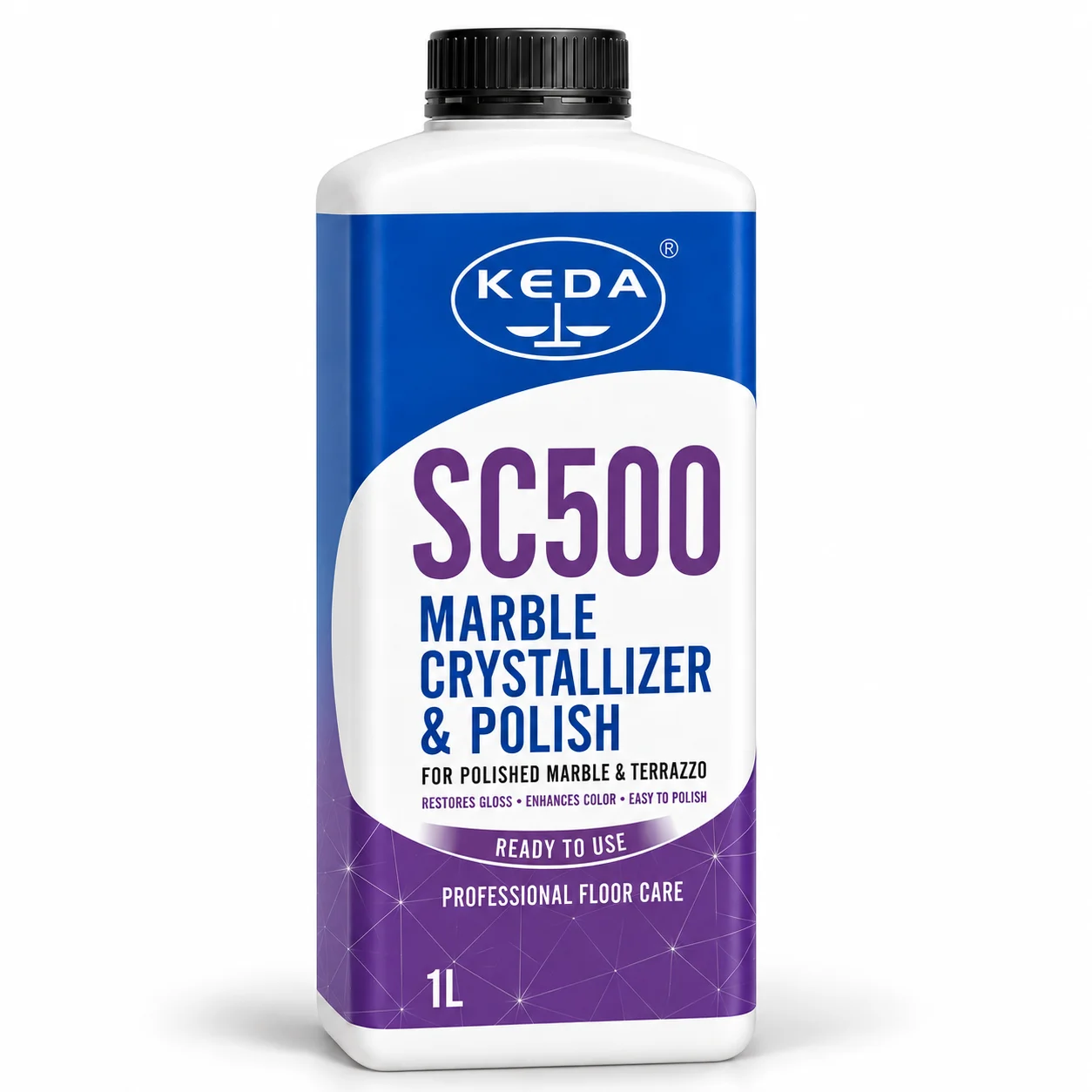
KEDA SC500 is a marble crystallizer and polish intended for professional floor-care programmes where maintaining or improving surface gloss is the objective. It is positioned for specialist maintenance contractors and facility teams working on compatible, properly prepared marble floors.
Assess the floor before selecting a treatment. Surface composition, existing finish, previous coatings and the degree of wear all influence the appropriate maintenance method.
Distributor enquiries & qualifying bulk orders
| Application focus | Professional marble-floor gloss maintenance |
|---|---|
| Selection details | Floor material · condition · machine and pad |
| Order requirements | Confirm supplied grade, colour, packaging and quantity |
Request the current product instructions and confirmed supply specifications for your application.
These are application enquiries, not blanket approvals. Granite, engineered quartz, porcelain, sintered stone and resin-bound terrazzo are outside the scope of this draft unless separately assessed and expressly approved for the actual product.
SC500 is not positioned as a crack filler, leveling material or general-purpose stain remover. Deep scratches, lippage, significant etching and damaged finishes may require a separate repair, honing or polishing programme before maintenance treatment is considered.
Changing the appearance of a surface does not establish waterproofing, stain resistance or slip resistance. Approve the finish and assess the floor's suitability for its intended use rather than judging the result from shine alone.
The proposed application is professional machine-assisted crystallization, not simply wiping a liquid onto the floor and leaving it to dry. Select the product, machine and pad as an approved combination.
Machine type, operating speed, pad material, product dose and working sequence must follow the instructions for the actual supplied product. Do not substitute an ordinary household scrubber or an arbitrary steel-wool grade, and do not assume that a faster machine gives a better result.
Review the materials and application before choosing the supplied grade.
This overview is for planning only. Obtain the actual product's use instructions and SDS before starting; it does not prescribe a machine speed, dosage, number of passes or reopening time.
Identify the material and finish, including any resin treatment, wax, sealer or coating. Record scratches, etching, cracks, loose areas and uneven joints. Address unresolved defects before specifying a gloss-maintenance treatment.
Remove grit and contamination using a compatible cleaning method. Prepare a clean surface in the moisture condition required by the confirmed instructions. Deal with existing coatings only through an approved removal method. Protect adjacent finishes, metal fittings and furniture, and isolate the work area.
Test the proposed product, machine, pad and dose together on a suitable sample or discreet area. After the prescribed finishing and cleanup steps, evaluate gloss, uniformity, color, residue and any surface damage. Assess the result under the lighting in which the floor will be used.
Treat manageable sections using the confirmed application and polishing sequence. Keep pads clean and change them as required. Avoid uncontrolled dosing, excessive local working and leaving a product-wet pad resting on the stone during a pause.
Remove polishing residues and loose pad material by the approved method. Check edges and joints as well as the main surface. Reopen only when the specified process is complete and the floor has been assessed as ready for use.
Use compatible routine cleaning and grit-control measures. Base further treatment on inspection, traffic and the actual product guidance, not on an invented fixed retreatment interval.
SC200 is positioned for enhancing the existing color of compatible stone. SC500 is positioned for professional crystallization and gloss maintenance on suitable floors. Color depth and surface gloss are different objectives; the products are not interchangeable or an automatically approved combined system.
Do not assume that hand application provides the intended result. This page is based on a professional machine-assisted process. Confirm the required equipment, pad and working method before use.
No. Identify the aggregate, binder and existing finish. Cement-bound terrazzo with suitable calcareous aggregate and resin-bound terrazzo are not the same surface system. Obtain specific approval rather than relying on the word terrazzo alone.
No such repair capability is established here. Assess damage first; a floor may need specialist repair, honing or repolishing before a maintenance product is appropriate.
Those properties are not established by this page. A glossy appearance is not evidence of safe traction, stain protection or acid resistance. Assess any required performance using the actual treated floor and appropriate evidence.
The packaging artwork says ready to use, but the supplied product's instructions must confirm dilution and application requirements. Pad material and grade must be selected for the actual formulation, machine and stone. Do not copy another brand's instructions.
Not without confirmed compatibility and sequence. Existing treatments can affect the process and finish. Neither SC100 nor SC200 should be specified automatically before or after SC500.
There is no universal interval assigned here. Review traffic, cleaning practice, surface condition and the actual product guidance. Frequent application is not automatically the solution to a dull, dirty or damaged floor.
Share the marble or terrazzo type, surface condition, previous treatments, approximate area and desired appearance with KEDA. Include photographs, available polishing equipment and the permitted maintenance window so the application can be reviewed before quotation.
KEDA SC500 Marble Crystallizer & Polish