

Compare marble adhesive quotations only after the product, quantity and delivery scope are clear. A lower price per container may cover a smaller capacity, a different grade, an incomplete component package or fewer delivery services.
Build one comparison sheet from the same purchase brief. Identify the adhesive and matching hardener, normalize the quantity, list included and additional costs, and resolve important gaps before selecting an offer.
This guide is for distributors, importers and stone fabricators comparing bulk purchases of polyester marble adhesive. It explains how to organize the commercial comparison without treating price as proof of workshop performance.
Give Each Supplier the Same Purchase Brief
Define the Product and the Intended Work
State the adhesive family, grade, consistency, base color and intended application. Include whether the material is for local filling, nonstructural edge assembly or another evaluated fabrication task. A general description such as “stone glue” is too broad for a useful comparison.
KEDA Colle pour marbre à base de polyester de qualité « Knife Grade » is listed with matched hardener and capacities of 1 L, 4 L and 20 L. Use the selected configuration in the inquiry rather than asking suppliers to quote whichever pack they normally sell.
Where a sample has been evaluated, identify the sample and accepted application in the purchase brief. Keep the product description consistent between technical discussions and the quotation. Our Guide de choix des colles pour marbre helps separate fabrication, repair and installation requirements before pricing.
Separate Confirmed Requirements from Options
List each color and capacity as a separate order line with its quantity and unit. Mark alternatives clearly, such as a different capacity to be evaluated separately. Otherwise a supplier’s proposed substitution can look like a lower price for the original request.
Add the destination, required arrival window, preferred delivery basis and documents needed for the order. Ask suppliers to identify exclusions and unresolved details explicitly. An empty field should remain a question, rather than becoming an assumed inclusion.
Normalize the Quantity Before Comparing Prices
| Champ « Devis » | What to establish | Comparison error it prevents |
|---|---|---|
| Product identity | Exact grade, consistency and base color | Comparing different materials under one generic name. |
| Price unit | Container, carton, kilogram, liter or another stated unit | Treating different units as equivalent. |
| Container content | Declared capacity or net weight and what it includes | Confusing adhesive content with the full kit or shipping weight. |
| Quantité commandée | Containers per line and confirmed packing multiples | Mistaking a carton quantity for a container quantity. |
| Matching components | Hardener identity, supplied amount and pricing arrangement | Comparing a complete package with adhesive alone. |
| Transport packing | Cartons, pallet arrangement, gross weight and dimensions | Estimating freight from nominal adhesive capacity alone. |
Keep Containers, Cartons and Pallets Distinct
A carton is a packing unit; its contents must be stated. A pallet is another packing arrangement with its own dimensions and weight. Neither tells you the number of saleable adhesive containers without a confirmed packing list.
For an illustrative quantity check, twelve 4 L containers and forty-eight 1 L containers both represent 48 L of declared adhesive capacity. This is arithmetic, not a KEDA packing recommendation or a real quotation. The two configurations can still differ in handling, consumption pattern and packing cost.
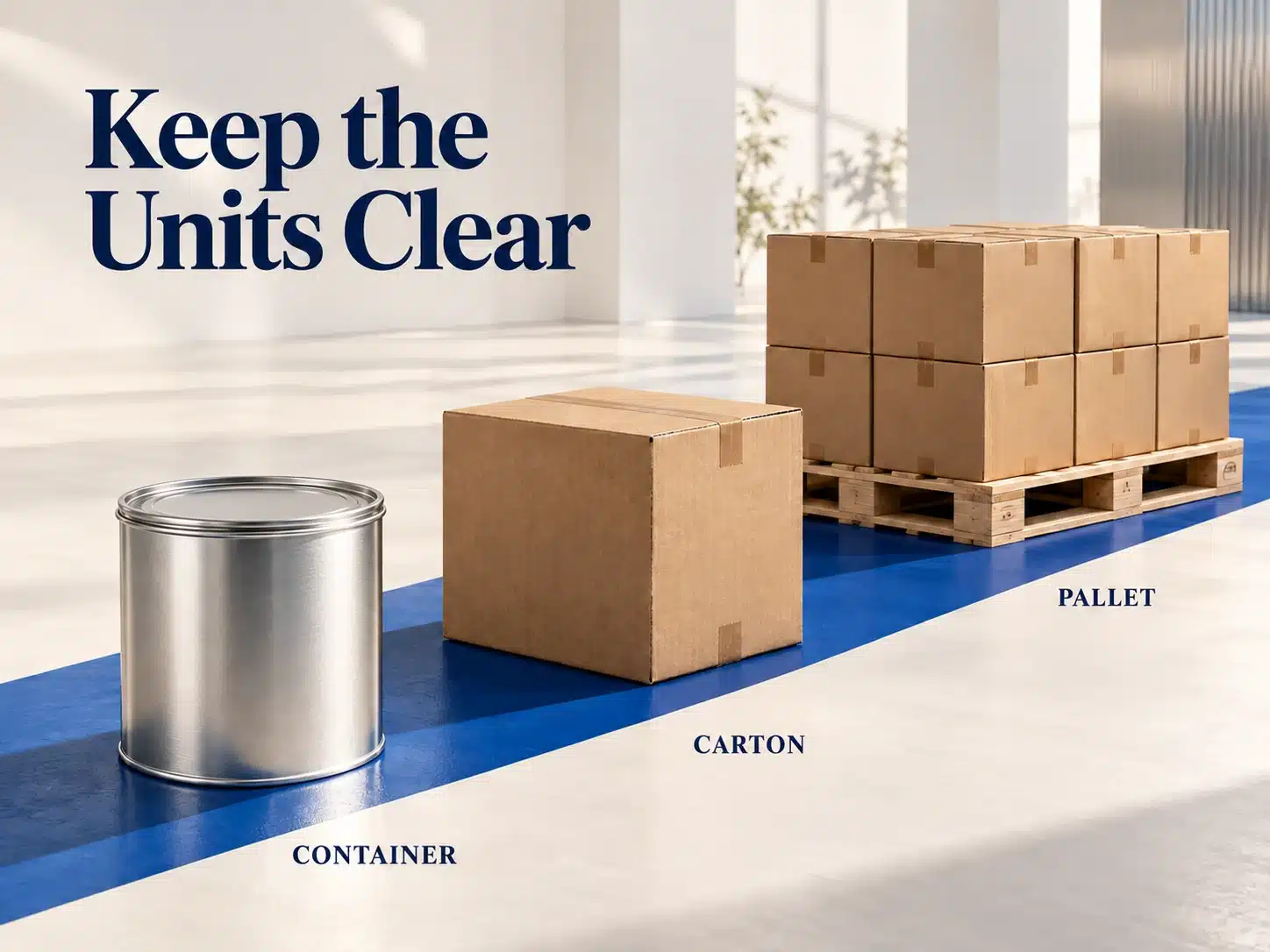
Confirm the contents of each packing unit. The illustration does not establish carton quantities or a pallet configuration.
Do Not Substitute Kilograms for Liters
Use the supplier’s confirmed net-content basis. A 4 L capacity does not establish a net weight of 4 kg, and gross shipping weight includes more than adhesive. Do not use an assumed density to make competing offers appear comparable.
If one supplier prices by weight and another by volume, request the product-specific information needed for an agreed conversion or ask for a common quotation basis. Keep the original quoted units visible beside any calculation.
When calculating a cost per liter, identify whether the denominator is the declared adhesive volume. Do not call it mixed-system yield, application coverage or usable production output unless those quantities have been established separately.
Confirm the Matching Hardener and Accessories
Define What Is Included in the Supplied Package
Record the adhesive and hardener identities, the amount supplied and whether the quoted price includes both. Ask how they are packed and identified. A statement such as “with hardener” still needs enough detail to connect the quotation to the supplied combination.
Do not infer the mixing ratio from a tube’s size or assume that every container capacity comes with an identical hardener arrangement. Use the current product instructions for dosing. A hardener from another adhesive family is not a substitute to make an incomplete offer comparable.
Ask separately about tinting accessories, measuring or dispensing equipment, labels and any other item the workshop expects to receive. If an accessory is optional, show it as optional rather than silently adding it to one offer only.
Keep the Technical Reference Attached
Request the available current product instructions and safety information for the actual components. Identify which technical or sample records support the intended use. A document for another grade does not resolve the specification of the quoted product.
For color-sensitive work, link the accepted base and any approved tint recipe to the order. Our color-matching guide explains why an identifiable finished reference is more useful than a color name alone.

Confirm the supplied combination and its identity. Container sizes and objects shown are not a dosing ratio or an actual packing specification.
Compare Delivery Costs to the Same Named Point
State the Delivery Basis in Full
Record the quotation’s delivery terms, the exact named port or place, and the version of any Incoterms® rule used. The three-letter term and the named location belong together in the comparison.
A quote for goods collected at one location cannot be compared directly with a quote including carriage to another destination. Ask the supplier and your logistics provider to identify their respective scope, exclusions and charges for the proposed shipment.
Keep cost comparison separate from responsibility and risk. A worksheet that adds freight costs is not a substitute for the agreed delivery terms or the purchase contract. Clarify those terms before treating an offer as ready to order.
| Cost or service item | What to ask | What to retain in the comparison |
|---|---|---|
| Goods and matched components | Which exact items and quantities are priced? | Quoted amount, currency, unit and included components. |
| Export packing and origin handling | Which packing and handling services are included? | Confirmed packing data and any separate charges. |
| Main carriage | Which route, shipment basis and destination are covered? | Freight scope, validity and charge basis. |
| Insurance | Is cover included or separately arranged, and on what basis? | The stated arrangement and any additional cost to be confirmed. |
| Destination processing | Which terminal, clearance, duty, tax or related items remain outside the offer? | Applicable estimates or confirmed charges from the responsible provider. |
| Final delivery and unloading | How far does the offered delivery extend? | Address or named point, included services and exclusions. |
Mark each item as included, additional, not applicable or unresolved, with a source and date. The table identifies questions; it does not assign responsibilities under a particular trade rule or determine tax treatment.

Bring quotations to the same delivery scope. The illustration does not allocate costs or risks under a trade rule.
Use the Actual Shipment Information
Provide the logistics provider with the proposed packing, component identities, safety information and relevant transport documentation. Ask what further product-specific information is needed for the selected route and transport mode.
Do not classify a shipment from the words “adhesive,” “hardener” or “sample” alone. Likewise, do not reuse freight from a different formulation or shipment configuration without checking its scope. The supplier and logistics provider need to review the actual offered goods.
Build a Transparent Cost Calculation
Choose a common comparison point and one reporting currency. Record the exchange-rate source and date if conversion is needed, while retaining the original quotation amounts. Keep estimates distinguishable from confirmed charges.
A useful working calculation is:
Compared acquisition cost = quoted amount + buyer-paid costs needed to reach the common comparison point that are not already included.
Assign each additional item once. If the quoted amount already includes a service, do not add it again from a separate freight estimate. If an important charge is unresolved, show the gap instead of entering zero.
Divide that cost by the agreed content unit only after the scope and quantity match. Cost per declared adhesive liter can be one purchasing metric; it does not establish equivalent bond performance, coverage or workshop productivity.
For a workshop comparison, retain preparation, finishing, material losses and observed rework as a separate evaluation. Quantify differences from records of comparable jobs. A low acquisition figure does not compensate for a product that fails the intended application requirements.
Check Timing, Validity and Commercial Conditions
Separate Production Readiness from Arrival
Ask what starts the production schedule: order confirmation, payment, approved packaging or another agreed condition. Record the estimated readiness date separately from transport time and expected arrival.
For a mixed order, confirm whether all lines will be ready together. Identify any split-shipment proposal and its effect on cost and documents. Avoid interpreting a general lead-time statement as a guaranteed delivery date for an unconfirmed assortment.
Record quotation validity and the validity of any freight estimate. When a product, quantity, route or schedule changes, request a revised offer that shows the new basis rather than carrying forward an expired comparison.
Make Order Conditions Visible
Compare payment stages, ordering minimums, packing multiples, remaining shelf-life requirements and the documents available at shipment. Ask what happens if the specified product or component changes before dispatch.
KEDA’s distributor and partner information provides a starting point for product combinations, packaging and cooperation discussions. Confirm the chosen order configuration and terms in the actual proposal, including the applicable brand arrangement.
Resolve the Gaps Before Issuing a Purchase Order
| Review item | Ready for the comparison when… | Clarify first when… |
|---|---|---|
| Product and technical reference | The offered grade and evaluated use are identifiable. | A generic description or substitution remains unexplained. |
| Quantity and units | Content, container count and packing are defined. | Weight, volume, cartons or kits are being assumed equivalent. |
| Components and accessories | Included and optional items are listed. | Hardener identity, amount or pricing is unclear. |
| Delivery and cost scope | The named point, inclusions and remaining charges are recorded. | Important costs are missing or counted twice. |
| Timing and validity | Readiness, transport assumptions and validity are current. | Dates are unsupported or an estimate has expired. |
| Order documents | The final offer, packing and product references agree. | Conflicting descriptions remain across documents. |
Summarize the reason for the selected offer and retain any open conditions. Reference the final quotation number or revision in the purchase order, together with the agreed specifications and delivery terms.
Keep the accepted product and component identities linked to incoming checks. Verify the delivered labels, quantities, condition and documents against the order. Our stone adhesive bond-testing guide covers the specimen and performance records that remain separate from a commercial price comparison.
Foire aux questions
1. Is the lowest price per container the best offer?
Compare the grade, content, matched components, delivery scope and intended performance first. A smaller or incomplete package can have a lower container price while representing a different purchase.
2. Can I compare a kilogram quote directly with a liter quote?
Request a common basis or the confirmed product-specific information needed for conversion. Do not assume one liter equals one kilogram. Keep net adhesive content separate from the full kit and gross shipping weight.
3. Should hardener be included in the comparison?
Record the specified matching hardener, supplied amount and pricing arrangement for every offer. The comparison should show the complete required combination, with optional accessories identified separately.
4. Does a quote including freight cover every destination cost?
Check the agreed delivery basis, named place and listed inclusions. Ask the responsible providers which destination processing, taxes, local delivery or unloading items remain outside the offer. Leave unresolved charges visible.
5. What should I send KEDA for a comparable quotation?
Send the intended work, selected grade or sample reference, colors, capacities, container quantities, required components, destination and timing. Add the preferred delivery basis and documents you need for the order.
Request a Marble Adhesive Quotation from KEDA
Before confirming a visible joint color on the order, approve a cured reference on the customer’s stone and record its ID.
Utilisez le ICC's Incoterms rules overview to check how a quoted term allocates transport obligations, costs and risk. Put the rule, named place and edition side by side before comparing any remaining charges.
Prepare one clearly identified order list and mark any alternatives or unresolved requirements. Contacter la KEDA with that list to discuss the product configuration, packing and delivery proposal for your market.


