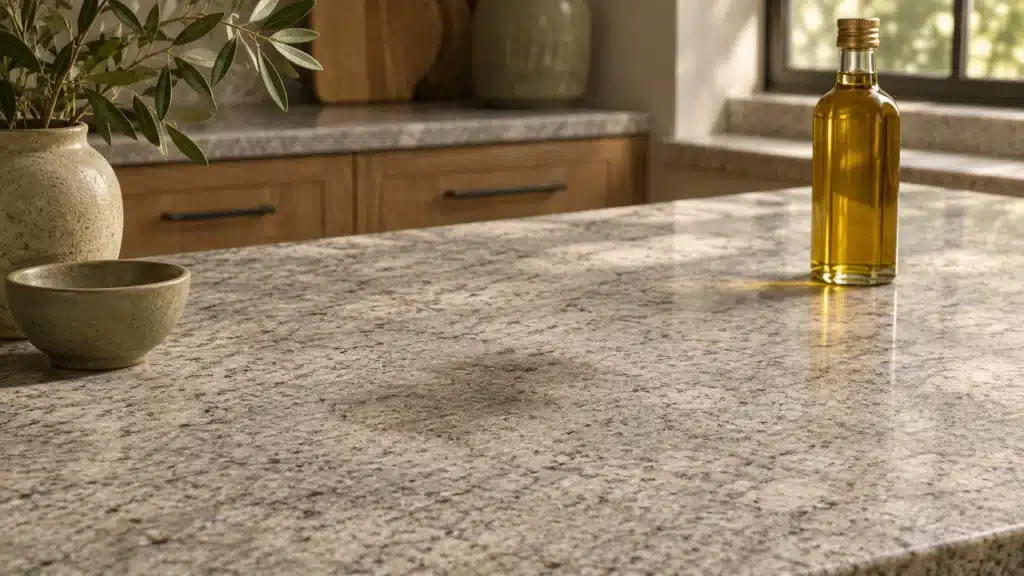
A greasy film on stone and an oil stain within the material are different cleaning problems. Removing the film can improve the feel and appearance of the surface while leaving a darker mark beneath it.
Start by identifying the stone, the likely source and what remains after appropriate cleaning and drying. That information helps separate a surface-cleaning task from a specialist stain-removal assessment.
This guide gives fabricators, maintenance teams and distributors a practical investigation sequence. It does not assign a cleaner, solvent or treatment recipe to every stone, and it makes no complete-removal promise.
1. Establish the Material and Spill History
Record the stone type, finish and any known factory resin, sealer, wax or coating. Include the grout, joint sealant, metal fittings and other neighboring finishes that a cleaning product might contact.
Locate the mark within its setting. Is it beside food preparation, cosmetics, machinery, a joint or a regularly wet area? Ask what was spilled, when it happened and what products have already been used.
The Natural Stone Institute identifies the source and pattern of a stain as important investigation clues. Its guidance also notes that oil-based staining can darken stone. A dark appearance alone, however, does not identify oil.
Photograph the area before changing it. Include an overview and a close view under consistent lighting. Record whether the surface is wet, recently cleaned or dry, because those are different observation conditions.
KEDA’s stone care range separates cleaning, protection, enhancement and specialist treatments. Choose the task before choosing a product name.
| Information to collect | Useful detail | What it helps establish |
|---|---|---|
| Stone and finish | Material identity, polished/honed/textured finish | Which cleaning methods may be considered |
| Previous treatment | Resin, sealer, wax or coating records | What else the cleaner could affect |
| Likely source | Known spill, nearby activity and recurrence | Whether oil is a supported explanation |
| Mark history | Age, location, spread and earlier attempts | What has changed and what remains uncertain |
| Current condition | Wet, recently cleaned or dry | Whether observations are comparable |
| Surrounding materials | Grout, joints, metals and adjacent finishes | What needs protection or separate review |
Keep unknowns explicit. A trade name for a stone or a photograph of a dark patch may leave material identity and treatment history unresolved.
2. Separate the Surface Layer From the Remaining Mark
Surface grease is material on the exposed face. Absorbed oil concerns contamination within an absorbent stone. Both can be present in the same area, so a cleaning result should describe what changed rather than giving the whole problem one label.
A slick feel or visible residue may support a surface-film investigation. A persistent darker area after the approved cleaning and required drying stage may justify a deeper review. Neither observation measures penetration depth.
Other conditions can confuse the picture. Moisture, uneven previous treatment, cleaner residue and natural variation may also change appearance. Dullness or disrupted reflections may indicate a finish issue that needs to be considered separately.
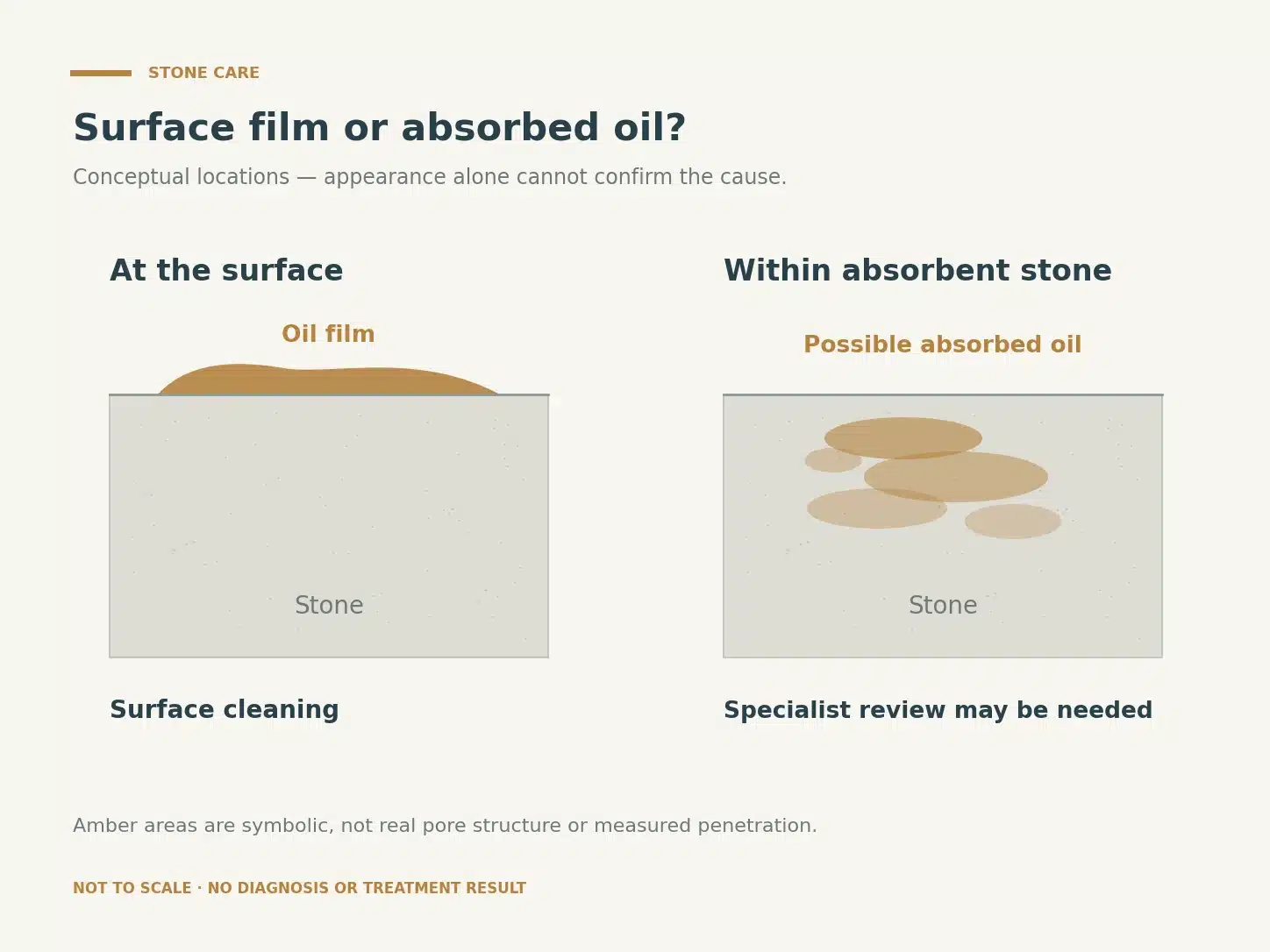
Conceptual locations only; not actual pore structure, measured penetration or a diagnosis of a particular mark.
The diagram explains why removing material from the face may leave another task unresolved. It does not establish that every persistent mark is absorbed oil or that a particular chemical will remove it.
KEDA SC300 Heavy-Duty Stone Cleaner & Degreaser is positioned for surface oil films, grease and accumulated grime on compatible surfaces. That role does not establish complete removal of oil absorbed into stone.
The Natural Stone Institute's guide to oil-based stains describes the darkening that can accompany an oil stain. If a dry area remains dark after suitable surface cleaning, document the mark and spill history before choosing a treatment for absorbed oil.
3. Contain a Fresh Spill Without Spreading It
For a known small oil spill, the Natural Stone Institute advises blotting rather than wiping the spill across the surface. Use a suitable clean absorbent material and follow the stone’s care instructions for the subsequent cleanup.
Keep the response focused on removing the spill. Do not spread it into joints or across a larger area while trying to produce a uniformly clean-looking surface.
Identify the substance before handling an unknown spill. A cooking-oil incident and an unidentified workshop liquid should not be treated as the same event. Follow the relevant product safety information where applicable.
Protect the working area from further use while cleanup is underway. For floors, manage access until the surface is safe to reopen. On counters, keep the assessment separate from food preparation and follow the applicable cleaning and use instructions.
After collecting the spill, record the remaining mark and the method used. That gives the next reviewer a clearer history than a sequence of unrecorded cleaning attempts.
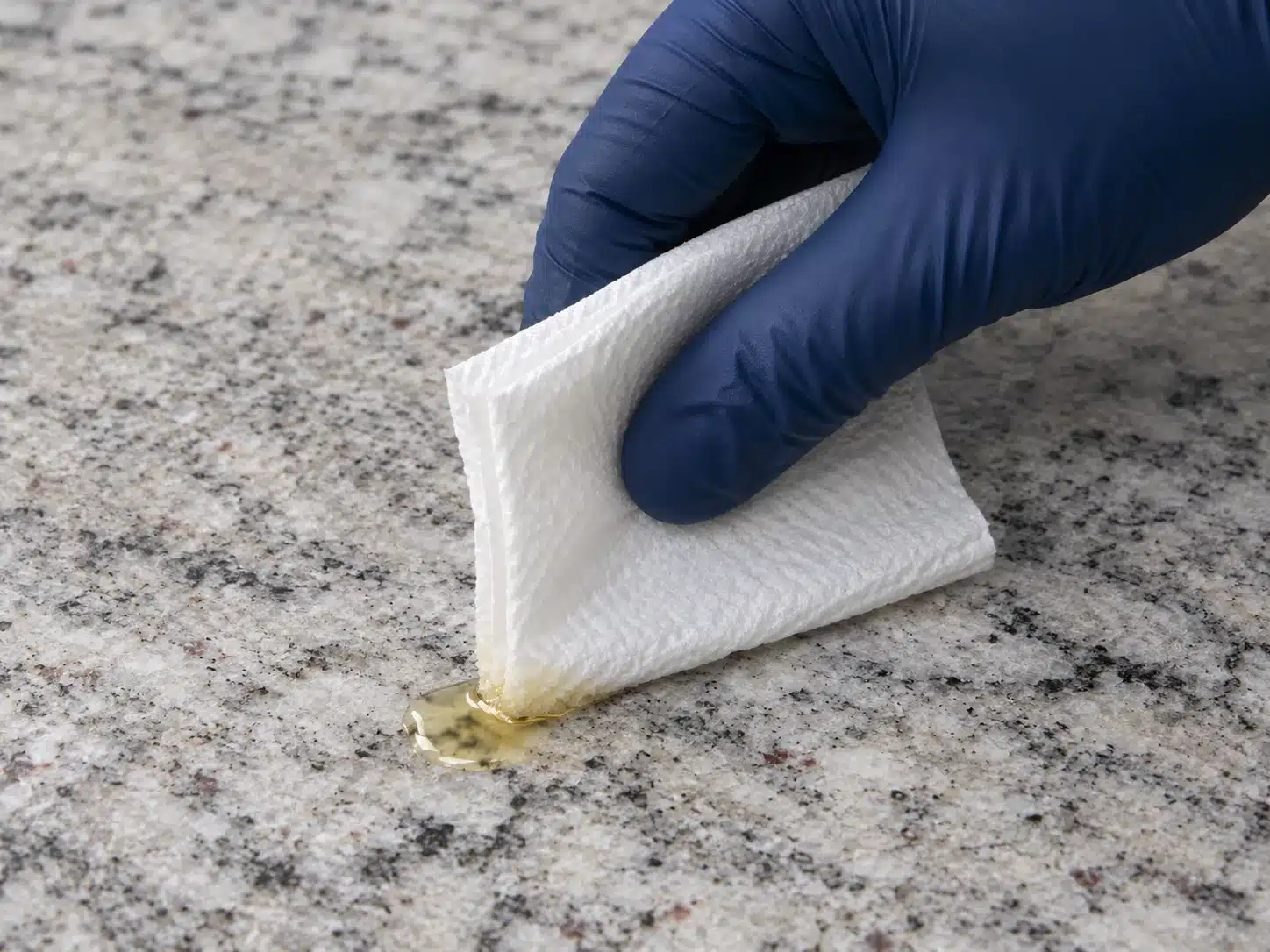
Illustrative blotting scene for a small known spill; not a product application or stain-removal result.
4. Confirm a Compatible Surface-Cleaning Method
Read the actual cleaner’s permitted materials and exclusions before testing. “Stone cleaner,” “degreaser” or “heavy-duty” does not establish suitability for polished marble, limestone, resin-treated surfaces or an existing protective treatment.
For SC300, obtain the supplied grade’s instructions and safety information. This article provides no dilution, contact time, chemistry or daily-maintenance recommendation.
Choose the proposed concentration, tool and contact period together. An approved product can still produce a different result when used with an unsuitable pad, excessive concentration or an extended exposure.
Test on a representative spare piece or an inconspicuous area only within the product’s permitted scope. A small trial does not override a stated material exclusion.
| Trial stage | What to define | Observation to preserve |
|---|---|---|
| Before cleaning | Material, finish, previous treatment and test boundary | Original appearance under recorded conditions |
| Application | Actual product, approved concentration, tool and contact period | How the stated method was carried out |
| Removal and rinse | Approved collection and rinsing procedure | Residue, spreading or effects on adjacent finishes |
| Dry review | Required drying condition and comparable lighting | Remaining mark, sheen, color and surface condition |
| Decision | Proceed, revise or seek specialist review | Reason for the next action and its limits |
Use an identifier such as OI-01 to connect the photographs, product record and observations. Keep any nearby untreated reference outside the area affected by the trial and subsequent rinsing.
Do not mix cleaners or add acids, bleach, solvents or other products to strengthen the chosen method. Use the actual label and SDS for handling, ventilation, protective equipment and collected-liquid disposal.
5. Remove the Dirty Solution and Review the Dry Surface
Carry out the confirmed cleaning method in manageable sections. Use the specified removal and rinsing process rather than moving dirty solution into the next area.
Protect moisture-sensitive construction and neighboring materials during cleanup. Avoid assuming that more water is harmless simply because the main surface is stone.
Observe the selected product’s requirements for keeping the solution from drying during treatment and removing residues afterward. Those instructions are different from the later drying stage used to assess the result.
Review only when the surface reaches the specified assessment condition. A cloth-dried face may still have a different moisture condition from the original reference. Do not assign an arbitrary waiting period from another cleaner or stone.
Compare the mark’s boundary, color and area alongside the reflected finish. Record whether the surface film was removed, whether residue remains and whether there is any change to the stone or its previous treatment.
A useful result can be partial: the greasy layer is gone, but a darker area remains. That observation supports a more focused next decision without claiming that the entire stain has been identified or removed.
6. Escalate Persistent Staining With a Defined Question
If a compatible surface-cleaning method leaves a persistent mark, pause before repeating a stronger version. Review the likely source, prior treatment, cleaning record and dry appearance together.
The Natural Stone Institute distinguishes surface cleaning from deeper stain treatment and notes that some stains may not be completely removable. Its poultice guidance describes drawing contamination into absorbent material; it does not make complete removal certain.
Specialist products may also have very different forms and restrictions. Lithofin OIL-EX, for example, is a dedicated paste treatment for oil-related staining. Its formulation and application instructions do not establish a KEDA recipe or approval for an unidentified surface.
Ask a stone-care professional or the relevant supplier which assessment or product system fits the actual stone and suspected stain. Provide the previous cleaning record so the review does not begin with an incomplete history.
Do not copy a homemade poultice recipe, overnight wrapping method or solvent treatment from another material. A specialist method still needs a confirmed material scope, application procedure and cleanup plan.
Where a further trial is agreed, preserve its identity separately from the first surface-cleaning test. Record any change in product or method rather than treating all attempts as one continuous procedure.
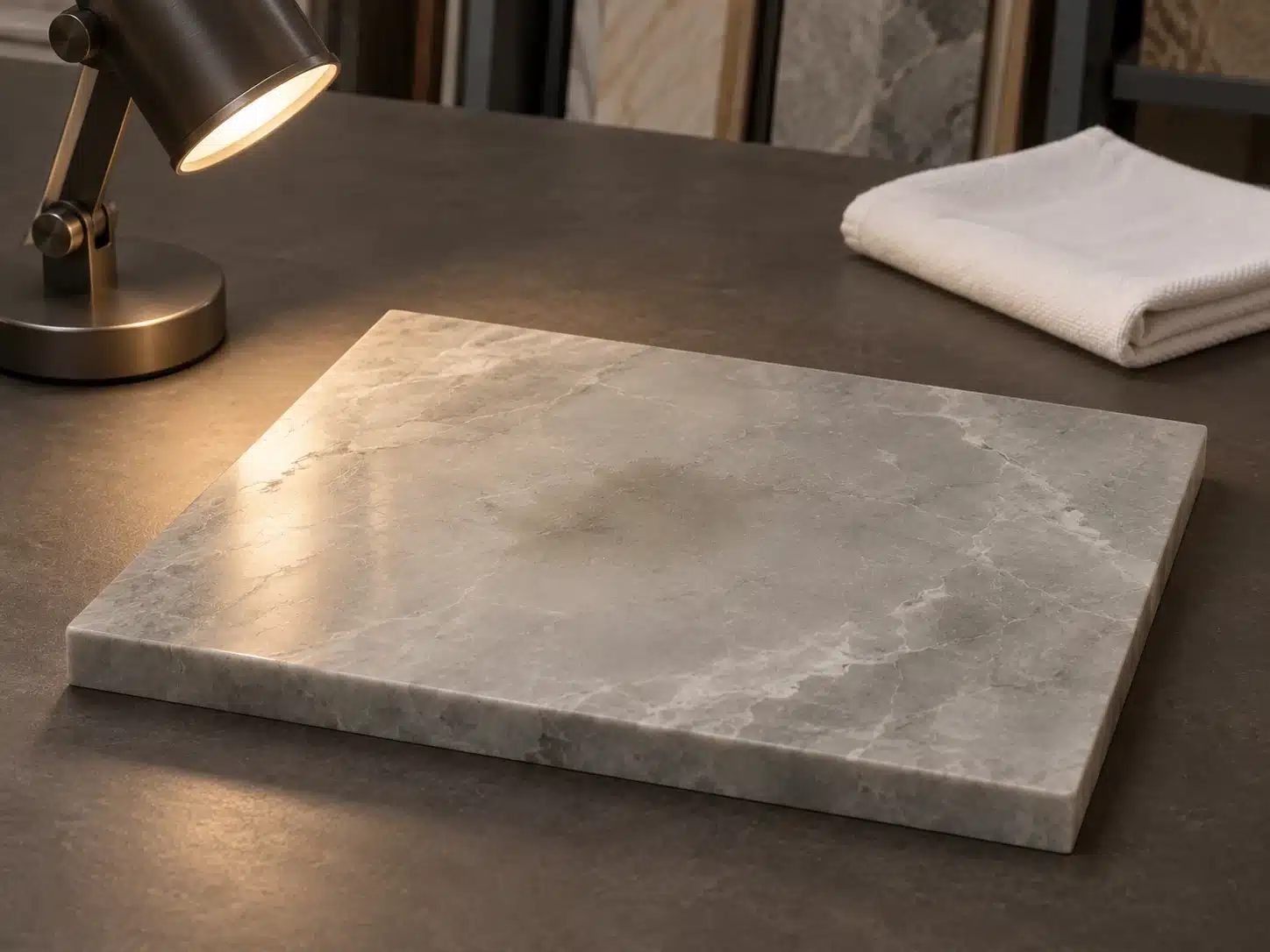
Independent visual-review scene; appearance does not confirm oil, drying completion or treatment effectiveness.
7. Keep Cleaning, Stain Removal and Finish Repair Distinct
A stain and surface damage can occur together. Removing contamination does not necessarily restore lost polish, and improving the shine does not establish that contamination has been removed.
Describe the unresolved task precisely. A dark patch, greasy film, dull region and changed coating are different observations, even if the customer initially calls all of them a stain.
| Remaining observation | Question to investigate | What not to assume |
|---|---|---|
| Surface film or residue | Was the approved cleaning and removal process effective? | That more concentrate is automatically appropriate |
| Persistent darker patch | Is the cause oil, moisture, treatment variation or something else? | That color alone identifies absorbed oil |
| Dullness or altered reflection | Has the finish or existing treatment changed? | That another cleaner will restore the original finish |
| Recurring mark | Is the source still active? | That repeated treatment has resolved the cause |
| Mark beside a joint | Is the source related to the joint or adjacent materials? | That nearby cooking activity proves the cause |
Keep any proposed finish-restoration work within a separately assessed method. Abrasive scrubbing can change the appearance while making it harder to understand the original condition.
Use KEDA’s stone protection and maintenance guidance to organize these tasks by purpose. A complete plan may require different decisions without creating an automatic sequence of products.
8. Assess Protection After the Existing Problem Is Resolved
KEDA SC100 Penetrating Stone Sealer is positioned for protective treatment of compatible absorbent stone. It is not a stain remover, and sealing over a remaining mark is not evidence that the mark has been addressed.
Before discussing protection, establish the cleaned surface’s condition, required drying and compatibility with existing treatments. Evaluate the proposed sealer on a representative sample and review its own appearance and service requirements.
KEDA SC200 Stone Color Enhancer serves a different appearance objective: enriching the stone’s existing tones. Do not use an enhancer to conceal unresolved oil staining or assume it will make a patchy surface uniform.
Neither product name establishes complete oil resistance, unchanged gloss or an approved combination with the cleaner. Select each task against the actual supplied grade and instructions.
For future care, address the source and establish a suitable spill-response and maintenance routine. Protective treatment does not replace prompt cleanup or the stone’s ongoing care requirements.
9. Send a Cleaning Brief That Supports a Decision
When discussing stone oil staining with KEDA, send material and finish details, the likely source, timing, earlier treatment history and photographs under identified conditions.
Include what changed during the surface-cleaning trial and what remained after the required drying stage. Provide the actual cleaner and method, not just “degreased twice.”
For distributor enquiries, separate the customer’s requested outcome from the product’s confirmed scope. Surface cleaning, specialist stain treatment, finish restoration and protection should each have a clear purpose.
The practical goal is a documented next step: identify the remaining problem, choose a compatible method and assess the result under comparable conditions. That gives the customer a more reliable basis for action than repeated stronger cleaning without a record.
After treating the identified oil stain, use the stone treatment selector if protection is still a separate project goal.
Frequently Asked Questions
1. Will a degreaser remove every oil stain from stone?
No. Removing surface oil and treating absorbed staining are different tasks. Match the product to the stone, finish and actual problem; complete removal is not guaranteed.
2. Does a dark patch prove that oil has soaked into the stone?
No. Review the spill history, moisture, previous treatments and dry appearance. Color alone does not establish the cause or penetration depth.
3. Can I use vinegar or another acid to remove an oil mark?
Do not choose an acid as a generic oil-stain treatment. Marble and other acid-sensitive materials can be damaged; use a method confirmed for the actual surface.
4. Should I seal the stone while a darker mark remains?
Resolve and assess the existing condition before selecting protection. A penetrating sealer is not a stain-removal treatment.
5. Can a color enhancer hide the oil stain?
It is not a corrective treatment for unresolved staining. Confirm the cause and cleaning outcome before evaluating any separate appearance treatment.