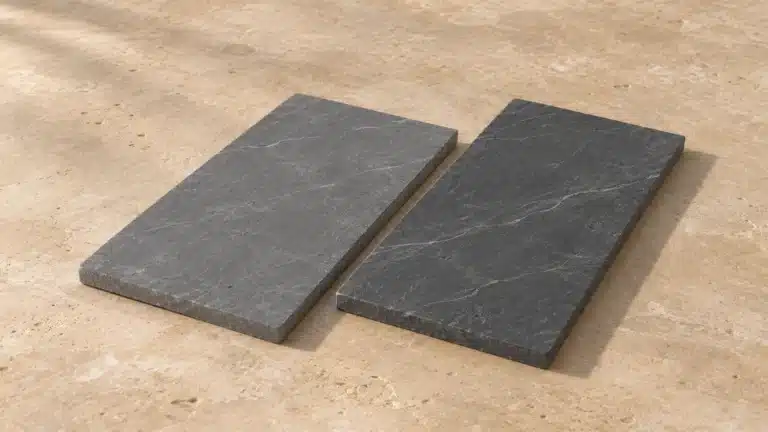

Choose by what needs to change. Use a sealer when the goal is protection, an enhancer when the stone needs a deeper tone, and a suitable finishing process when the goal is more sheen. If dullness appeared after cleaning, or the surface has a new ring, haze, or stain, identify the cause before choosing a treatment.
| What the customer sees or wants | Start here | What confirms the choice |
|---|---|---|
| The finish looks right, but the stone needs protection from relevant spills | Review a suitable penetrating sealer | Documented suitability for the exposure, plus an acceptable dry appearance |
| The stone looks too pale; the existing sheen is acceptable | Trial a compatible color enhancer | The approved dry tone and vein contrast on the actual stone |
| The surface needs more reflection or the gloss is uneven | Assess the finish and choose an appropriate maintenance or restoration process | The desired sheen and texture on a completed trial area |
| A new dull ring, white haze, scratch, or dark patch | Diagnose the mark before selecting a treatment | A cause and a suitable correction method |
Diagnose marks before treating the whole surface
Look at the clean, dry stone in diffuse and side light. Review what changed: a spill, a cleaner, a previous product, wear, or a moisture event. A dull ring could be a change in the finish rather than a removable stain. A patch that appears after cleaning may be residue or surface damage. Start with the guide to dull marble after cleaning if the cause is unclear. Note the material, finish, age of the installation, and any existing treatments.
Choose protection or a richer color
Consider SC100 Penetrating Stone Sealer when protection is the priority on compatible absorbent stone. Check the actual exposure and confirm how much change in the dry appearance is acceptable. Consider SC200 Stone Color Enhancer when the customer wants to enrich existing tones. Some enhancing products also offer protection, but confirm that function for the product and use in question.
If you already know the choice is between these two treatments, use the SC100 vs. SC200 sample guide to compare separate trials with a dry control and record the acceptance decision.
Decide what “polish” means on this job
A deeper color can still have a matte finish. To judge sheen, observe a reflection at an angle and check whether the customer wants a surface finish changed or simply maintained. Where etching, scratches, or wear have altered the finish, a stone specialist may need to assess honing or repolishing. Adding a finishing product does not restore material lost from the surface.
KEDA SC500 Marble Crystallizer & Polish is intended for professional gloss maintenance on compatible floors. Stone Polishing Wax is a separate finishing option for approved surfaces. When considering either, confirm the stone and existing treatment, intended method, and use of the area. For a walking surface, assess slip resistance separately wherever required; higher gloss does not establish traction.
Begin with dullness after cleaning if the appearance changed during cleaning, or haze after sealing if it appeared during treatment. For available treatment grades and intended uses, see the KEDA Stone Care product range.
Before treating a larger area, approve a representative result under the intended lighting. For product selection, send KEDA the stone, finish, previous treatments, a photo of the concern, and the result the customer wants to achieve.