When both bonding faces are nonporous, check the adhesive’s curing requirements before installing the parts. A product can have good initial grab yet need a particular route for moisture transfer or drying. The exposed edge can also look different from material concealed inside the assembly.
First identify the supplied adhesive, its cure mechanism and the actual contact surfaces. Then confirm the permitted application pattern, bond-line thickness, conditions and support period. Do not infer these requirements from a high-tack or multi-purpose product name.
KEDA’s construction adhesive range offers enquiry routes for interior mounting, mirrors and selected bonding or sealing tasks. Describe both surfaces and the assembly geometry when requesting a recommendation.
1. Identify the Surface the Adhesive Will Actually Touch
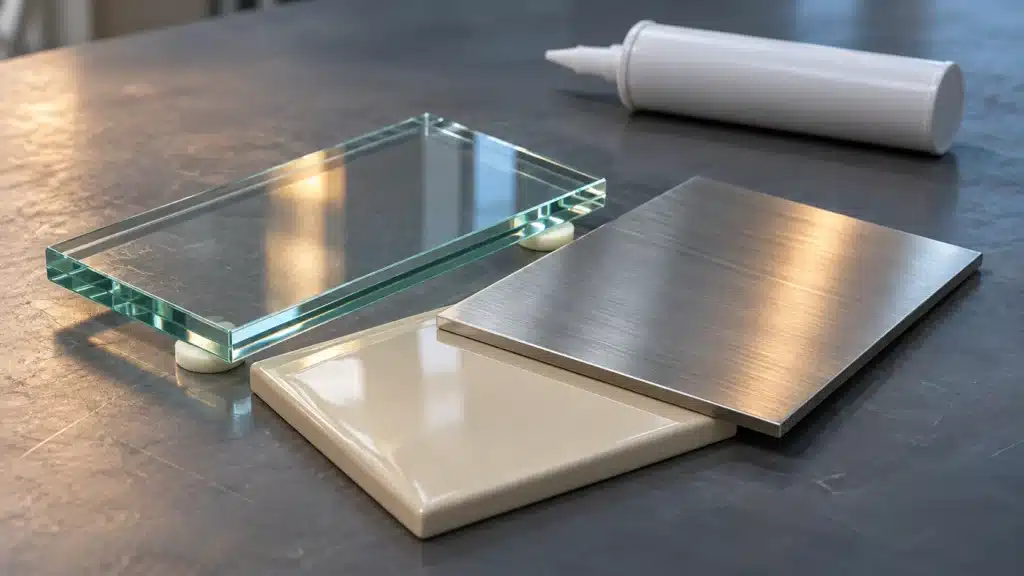
Record each bonding face, including its finish. Bare metal, powder-coated metal and painted metal are different interfaces. A ceramic tile may present either a glazed face or an unglazed back. A nominally absorbent board may have a coating that changes the surface presented to the adhesive.

Illustrative material references. Appearance alone does not establish permeability, compatibility or preparation requirements.
Ask for material and coating identities rather than relying on descriptions such as smooth, shiny or waterproof. Identify old adhesive, release films and other treatments that may remain on the proposed contact area. Photograph both faces before they become concealed.
Check compatibility and substrate strength separately from cure. An adhesive that cures normally can still be attached to a poorly bonded coating. Likewise, choosing a suitable cleaner does not establish that the selected adhesive can cure within the proposed enclosed arrangement.
Record panel dimensions, the contact area and which edges remain accessible. These details help the supplier evaluate the whole assembly rather than a small isolated material sample.
2. Confirm the Cure Mechanism Before Choosing the Layout
Construction adhesives do not all solidify by the same process. Ask for the actual product’s current technical and application information. Use that information to establish what the bond needs during curing.
| Product mechanism to confirm | Relevant curing question | What must not be assumed |
|---|---|---|
| Water-based dispersion adhesive | How can released water leave the bond? | That two impermeable faces provide a suitable drying route |
| One-part moisture-curing adhesive | How does sufficient moisture reach the adhesive in this geometry? | That an exposed skin proves the concealed material is ready |
| Two-component reactive system | Were the correct components measured and mixed, and are conditions suitable? | That open edges compensate for an incorrect ratio or incomplete mixing |
Some water-based products require a water-vapor-permeable bonding surface. Some one-part moisture-curing products restrict full-surface applications because the concealed material may not cure as required. These are product-specific selection issues, not permission to transfer one manufacturer’s application method to another adhesive.
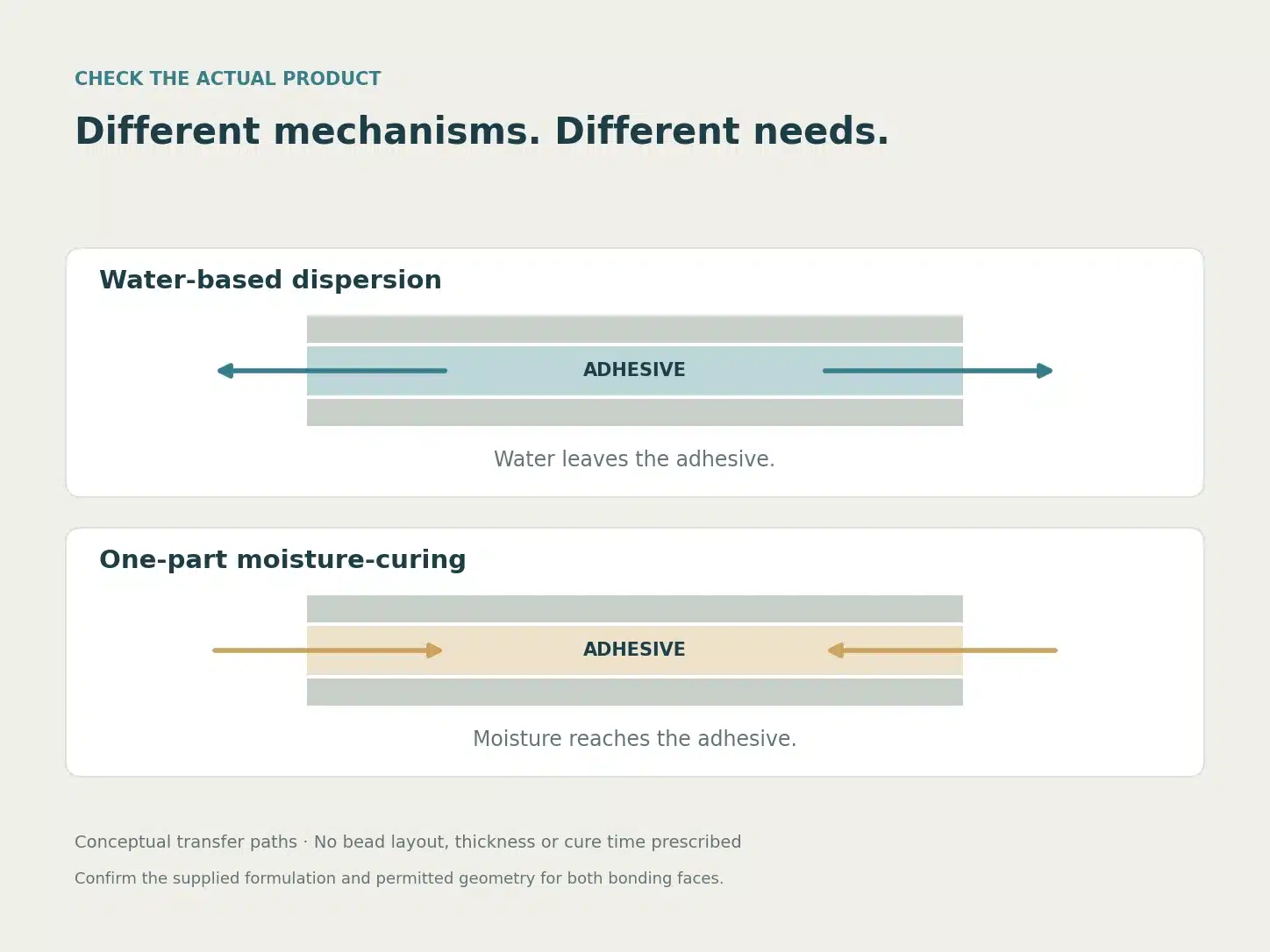
Mechanism comparison only. Arrows show different transfer needs; they prescribe no application pattern, thickness or curing time.
KEDA’s Multi-Purpose Adhesive & Sealant is a route for discussing selected interior bonding and connection-joint sealing. Confirm the supplied grade’s chemistry and curing requirements rather than assigning it a mechanism from the product name.
3. Distinguish Initial Grab, Skin and Cured Performance
Initial grab concerns holding during placement. Skinning concerns the exposed surface. Cured performance concerns the material and bond at the stage required for the intended operation. Record these as separate observations rather than treating them as interchangeable signs of readiness.
Also distinguish an elastic cured adhesive from uncured paste. Some products are intended to remain flexible. The fact that a bead can be indented does not by itself establish a curing failure, just as a dry-looking edge does not establish adequate cure throughout a concealed layer.
Use the supplied product’s criteria and an agreed sample-review method. Do not repeatedly pull or twist an installed panel to see whether it is ready; that can disturb the assembly being assessed. Keep the required supports in place while any uncertainty is resolved.
When reviewing KEDA High-Tack Mounting Adhesive, separate the initial holding requirement from the curing and support requirements. The name alone does not establish a loading time or demonstrate compatibility with a particular pair of nonporous faces.
4. Confirm Geometry Without Inventing a Bead Pattern
Provide a sketch showing the component, substrate, proposed adhesive placement and any later perimeter sealing. Ask the supplier to confirm the pattern and installed thickness for the actual materials, dimensions and load.
Do not change beads into a continuous spread simply to increase the apparent bonding area. Do not close all edges to make the assembly look finished unless the approved sequence allows it. For products that depend on transfer to or from the environment, those changes can matter.
The opposite shortcut is also unreliable: an arbitrary gap, a few extra dots or a smaller contact area is not a verified cure solution. The layout must satisfy both curing and attachment requirements. A configuration that improves one condition may not provide the required bond arrangement.
Check how positioning pressure affects the installed geometry. Confirm spacers or other controls only where specified, and retain required permanent fixings. More adhesive or harder clamping is not a substitute for the selected arrangement.
For mirror work, the reflective backing introduces a separate compatibility question. Use the KEDA Mirror Adhesive enquiry route with the mirror manufacturer’s backing and fixing requirements. Ordinary glass compatibility does not establish suitability for a mirror backing or its installation.
5. Reproduce the Assembly in a Separate Trial
Make a representative mock-up before committing a large area to the proposed adhesive. Include both actual surface finishes, preparation products and the specified geometry. Where component size affects the curing arrangement, agree how the sample will represent that condition rather than using an unrelated small dab.
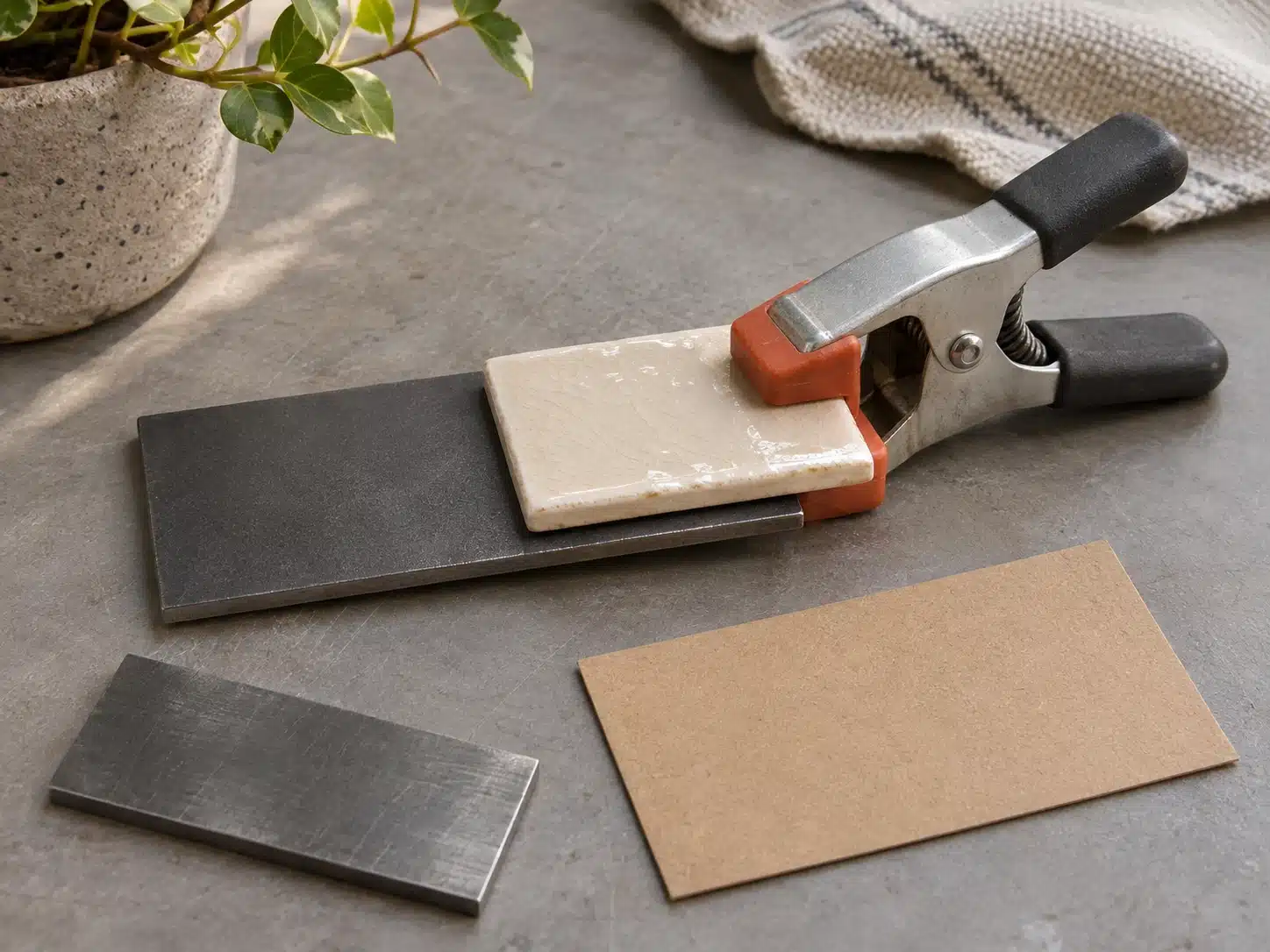
Illustrative supported trial. It demonstrates no approved layout, clamping pressure, compatibility or internal cure state.
Give the trial a reference such as NP-01. Record when the adhesive was applied, when the parts were assembled and whether the permitted working window was met. Include cleaning, primer where specified, temperature, humidity and any change in the environment during curing.
Agree on how the concealed region will be assessed using designated specimens. Opening, cutting or otherwise evaluating a separate sample needs a suitable method and review stage. Do not use an installed load-bearing component as an improvised destructive test.
Assess material cure, adhesion and substrate condition separately. Record whether an observed separation occurs at the adhesive interface, within a coating or elsewhere. A neat external edge should not replace evaluation of the parts of the bond relevant to the actual application.
| Sample record | Include | Purpose |
|---|---|---|
| Adhesive identity | Supplied grade, batch and current instructions | Establishes the relevant cure and use requirements |
| Both contact faces | Material, finish, coating and preparation | Represents the actual interfaces |
| Geometry | Component size, adhesive layout and installed thickness | Defines the arrangement under review |
| Conditions | Application and curing environment over time | Records more than a single room reading |
| Assessment | Specimens, method, stage and acceptance basis | Makes observations meaningful and repeatable |
If a sample is changed, identify the revision. A different cleaner, coating, thickness or perimeter treatment can change the situation that was originally reviewed.
Keep an unused material reference alongside the trial so the original finish can be compared with any later separation. If an exposed adhesive bead is retained for comparison, label it separately: it experiences different conditions and cannot certify the concealed bond. Use photographs with the sample reference and observation time so edge and interior observations are not confused.
Agree in advance what happens when the result is unclear. For example, a trial may need a revised product recommendation or another representative specimen before work proceeds. Define who reviews the record and who authorizes the next installation step. This prevents an incomplete observation from becoming an informal approval when the work changes hands.
6. Troubleshoot Soft Material Without Guessing the Remedy
If material remains softer than expected, preserve the sample and its history. Confirm that the observed condition differs from the product’s intended cured state. Then review product identity, storage, preparation, geometry and conditions together.
Check whether the reference curing information describes a test bead or conditions different from the enclosed bond. Do not multiply a published rate by the apparent layer thickness and treat the result as a guaranteed loading schedule. The actual geometry and transfer route still need consideration.
Review whether the two faces are more closed than expected because of coatings or treatments. Check any perimeter seal added after positioning. Document these details before removing material, since dismantling can erase evidence of the original arrangement.
Avoid adding water, solvent or another product to force a remedy unless the supplied instructions explicitly specify a method. General room ventilation may be important for handling and some drying processes, but it does not establish the required conditions inside every closed bond.
If the assembly cannot be maintained in its required condition, obtain a product-specific decision on correction or replacement. Waiting longer can be part of an approved approach, but it does not automatically resolve incompatible materials, an unsuitable product or a geometry outside the permitted use.
7. Keep Support and Release Decisions Explicit
Plan support before application. Identify temporary holding, permanent fixings, the weight and position of the component, and the stage at which each support may be released. Use the actual product and installation requirements for that decision.
Keep supported work identified when it moves between shifts or locations. Record any disturbance, change in conditions or alteration to edge access. Do not allow finishing work to conceal a bond whose condition is still being assessed.
Before loading or reopening the area, complete the specified checks. Separate cosmetic completion from readiness for handling and service. If a later operation needs perimeter sealing, painting or other treatment, confirm its timing and compatibility within the complete sequence.
This guide addresses nonstructural installation planning. Structural glazing, overhead attachment and other critical assemblies need their own approved products and designs; a successful small mock-up does not establish those permissions.
8. Send a Complete Cure Enquiry to the Supplier
Use the sample record to describe the problem without diagnosing it from a photograph. Include what remains soft, where it was observed, the elapsed time and the expected criterion. State which details are unknown so the supplier can identify the missing information.
| Enquiry field | Useful detail | Question it helps resolve |
|---|---|---|
| Actual product | Grade, batch, storage history and instructions | Is the intended mechanism and application known? |
| Materials | Both contact faces, coatings and treatments | Are compatibility and permeability assumptions valid? |
| Assembly | Sketch, dimensions, placement and edge treatment | Does the layout match the permitted method? |
| Conditions | Temperature, humidity, timing and changes | Does the curing history match the guidance? |
| Observations | Sample photographs and agreed assessment results | What condition requires further investigation? |
For distributors, the same record helps distinguish an application question from a product-quality concern. Use KEDA’s distributors and partners page to discuss the applications your customers serve and the information needed with the supplied grades.
Send the material pair, assembly sketch, NP-01 record and expected quantity through KEDA’s contact page. Ask for the confirmed product, layout and curing requirements for that application rather than a universal wait for every nonporous joint.
Frequently Asked Questions
1. Can construction adhesive bond two nonporous surfaces?
Some products can when selected and applied for the actual materials and geometry. Others require a permeable surface or a particular arrangement. Confirm the supplied grade rather than relying on the general product category.
2. Does a dry edge prove the adhesive inside has cured?
No. The exposed edge and concealed region can experience different conditions. Use the selected product’s requirements and an agreed representative assessment before releasing support or applying loads.
3. Should I spray water into a slow-curing bond?
Do not introduce water unless the actual instructions specify it. Different mechanisms have different needs, and adding moisture is not a general remedy for soft adhesive between closed surfaces.
4. Is flexible adhesive necessarily uncured?
No. Some cured adhesives remain elastic. Compare the observation with the intended product properties and specified assessment criteria; softness alone is not a complete diagnosis.
5. Will leaving the assembly longer always solve the problem?
No. Additional time cannot be assumed to correct unsuitable chemistry, incompatible surfaces or an unapproved layout. Keep the assembly supported and obtain a product-specific assessment of the recorded conditions.