
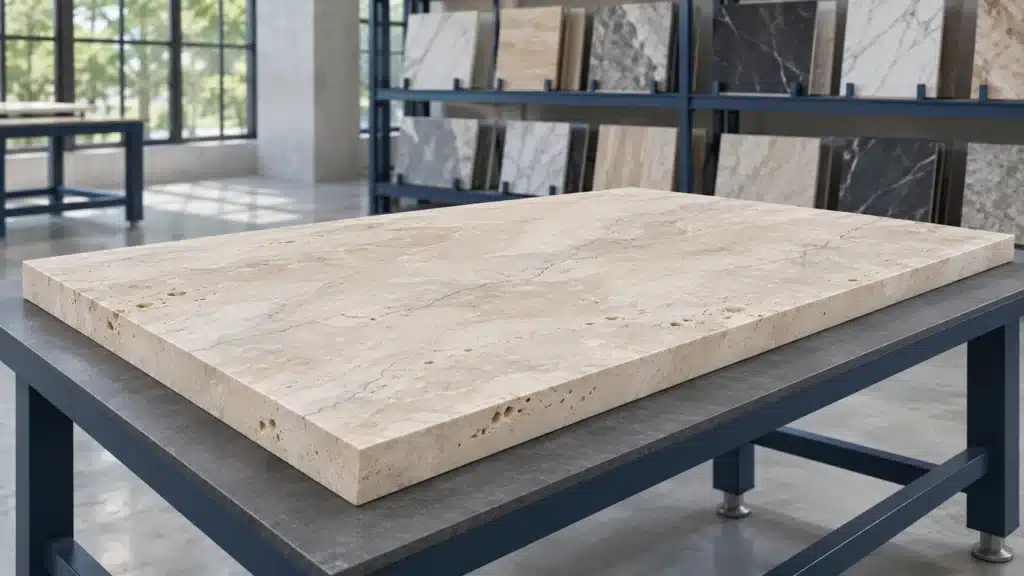
A stone slab can be repaired or resin treated at the factory and still need a separately selected adhesive at installation. Decide which operation you are buying for: filling or treating the slab before finishing, or bonding the finished slab to its installation substrate or support.
| Task | What the material must do | What to approve |
|---|---|---|
| Resin treatment or repair during processing | Work with the defect, stone and planned finishing sequence | Appearance and process results on the treated slab |
| Installing an interior wall panel | Bond the actual panel backing to the prepared substrate within the approved detail | System compatibility, positioning and supported cure |
| Bonding stone to a support in an engineered assembly | Perform at the interface shown in the project detail | Required evidence for the stone, support, adhesive and specified fixings |
Hand the finished slab over with its backing identified
A polished face is the wrong surface to use for an installation approval if the adhesive will meet mesh, cured resin or another backing. Ask the fabricator to identify the back treatment and any repairs or changes between lots. Record both mating faces, the joint detail, adhesive thickness or gap requirement, service exposure and support arrangement. Have the installer review the mesh-backed and resin-backed stone checks before choosing an installation product.
In KEDA’s range, KD‑015 is a fabrication-stage enquiry. The Low-Odor Epoxy Slab Adhesive is an option to review for designated interior porcelain slab or sintered-stone wall-panel applications. 2-Component Epoxy Structural Adhesive is a separate enquiry for project-defined rigid interfaces. Neither a finished repair sample nor the word “epoxy” substitutes for the approval of the installation detail. Keep the specified fixings and supports.
If the question is which material to use at the workbench, see slab treatment versus fabrication-joint glue. Send KEDA the slab backing, substrate, joint detail, exposure and support arrangement to confirm the intended material role and the information needed for installation.


