

Before adjusting marble adhesive that feels too thick or too runny, identify the grade, the material stage and the conditions of the observation. A knife-grade base, a flowing repair resin and a mixed batch approaching the end of its working period are different materials to assess.
Describe the task that is difficult: taking adhesive from the pack, mixing the components, spreading a layer, filling the detail or keeping material in place. That description gives the supplier and workshop a useful starting point.
This guide provides a practical workability check for stone fabrication. It does not establish a universal viscosity target or a recipe for modifying the supplied product.
1. Check the Grade Before Calling the Consistency Wrong
Start with the label and intended operation. KEDA’s Knife Grade Polyester Marble Adhesive is supplied as a knife-grade paste for suitable nonstructural fabrication and local repair. It should not be judged against the pouring behavior of a different low-viscosity resin.
KEDA’s stone fabrication and repair guidance distinguishes joints, edge assembly and filling tasks. Identify the actual detail, access and application tool before deciding what handling behavior the job needs.
Product descriptions such as paste-like, flowing or thixotropic need their stated context. They are not interchangeable viscosity specifications, and they do not establish every product’s response to stirring.
Manufacturer examples show the difference. AKEMI describes Marble Filler 1000 S as a stiff paste whose consistency does not change with stirring, while its 1000 Thixo documentation describes easier handling through stirring or spreading. These are examples of different formulations, not instructions to apply either behavior to KEDA.
If the selected grade does not suit the task, review product selection before trying to turn it into another material with additives.

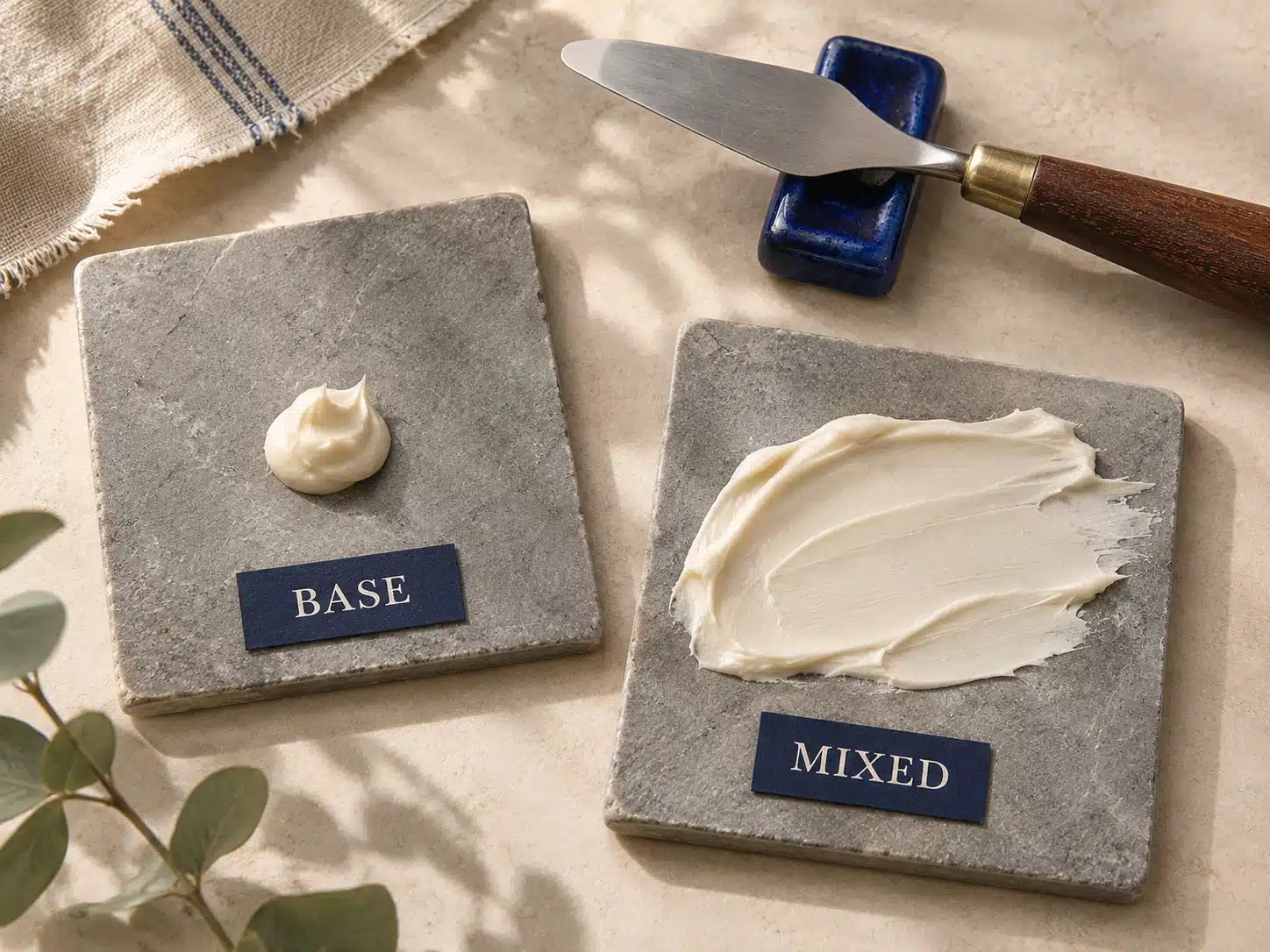
Editorial paste-category illustration. The ridge is not a measured viscosity target or a KEDA non-sag test.
2. Identify Exactly Which Material You Are Observing
Separate the base adhesive from its curing component and from the mixed batch. Record when the behavior appeared and whether it changed during use. Keep original-component observations distinct from mixed-material observations.
| Observation point | Information to record | Question it helps resolve |
|---|---|---|
| Base material before use | Product identity, opening history and condition | Is the concern present before components are combined? |
| After any instructed preparation | Exact permitted preparation and tool | Was the supplied preparation method followed? |
| During component mixing | Amounts, measurement basis, method and additions | Is the concern related to the actual mixing process? |
| After mixing, before application | Elapsed time, quantity and container | Is the batch still within its permitted working stage? |
| During spreading or filling | Stone face, geometry, tool and timing | Is the problem specific to the application detail? |
For a two-component epoxy, identify which component or combination is being discussed. A description such as “the gray material is thick” is incomplete if the supplied color version or component identity has not been confirmed.
For polyester marble adhesive, record the matched hardener and any compatible color paste separately. An observation made after tinting should include that addition history.
Photograph the condition before changing it. If the material has unexpected lumps, a surface skin or an unidentified liquid layer, preserve the observation and request guidance rather than assuming ordinary stirring will restore it.
Fictional stage-identification example. Similar appearance does not establish the same material state; the amounts shown are not a mixing ratio.
3. Describe Handling with a Repeatable Task
Replace “bad consistency” with an observable action. Useful descriptions include “difficult to lift with the normal spatula,” “does not spread across the prepared detail as expected,” or “loses placement control before the parts are positioned.”
Identify the tool, amount taken and surface used. A narrow blade, a broad spatula and a different application angle can give different impressions of the same material. Keep the actual production tool in the review.
Separate spreading resistance from curing, adhesion and final strength. A paste that feels easy to spread has answered a handling question; it has not demonstrated its bond performance or machining readiness.
A short video can help show the action and the relevant stage. Include the material identity and timing in the written record. Avoid presenting a freehand spatula demonstration as a standardized viscosity or slip-resistance test.
Define the practical requirement before comparing results. The operator may need enough control to fill a small cavity, coat a specified interface or assemble an edge within the permitted period. Those are more useful requirements than asking for the thinnest possible adhesive.
4. Record Temperature Without Inventing a Conditioning Method
Compare material under relevant, documented conditions. Record the product’s storage history, workshop conditions and any available material or surface temperature measurements. A cold pack recently brought indoors is not equivalent to a pack already held under the permitted application conditions.
Temperature can affect resin handling and reaction behavior. WEST SYSTEM’s cold-weather epoxy guidance describes increased viscosity in cold material and resulting dispensing and mixing difficulties. This supports checking conditions; it does not provide KEDA temperature limits or authorize the same warming procedure.
Use the actual grade’s storage and application instructions to plan conditioning. Confirm the permitted method before heating or cooling material. Do not use an improvised hot-water bath, heat gun or solvent addition as the default response to stiffness.
Include the stone and work area in the assessment. Bringing a pack to an acceptable condition does not establish that the bonding surfaces meet their own preparation requirements. Check for condensation where transfer conditions make it relevant.
Keep measurements separate from estimates. If no temperature was measured, report that gap rather than adding a number from a weather forecast.
5. Watch for Changes After the Components Are Mixed
Begin the mixed-batch record when the components are combined, using the timing definition in the supplied instructions. Track mixing, application and positioning as separate operations within the permitted working period.
A batch that becomes progressively harder to spread needs a different review from a base material that was unusually stiff before use. Record the progression instead of treating both as the same viscosity complaint.
Check the quantity and container against the confirmed method. Changing from a small preparation to a larger contained batch changes the comparison. Plan the amount around what the operator can mix, apply and position under the actual instructions.
Complete fitting and support arrangements before mixing so the available time is used on the intended work. If material passes its permitted application stage, stop using that batch and follow the handling and disposal instructions.
Do not try to restore an advancing mixture by adding fresh adhesive, extra curing component or unapproved liquid. A mixture that becomes easier to move after an improvised adjustment has not thereby regained an approved working condition.
6. Keep Workability and Component Dosing Separate
Use the matched curing component and confirmed measurement basis for the supplied grade. For polyester marble adhesive, the hardener dose is part of the product instruction, not a free adjustment for making the paste easier to spread.
For KEDA’s specified 2-Component Epoxy Structural Adhesive, A:B is 1:1 by volume. Equal weights are not an established substitute. Preserve the specified ratio while reviewing handling and application conditions.
| Proposed shortcut | Issue to resolve instead |
|---|---|
| Add solvent or water to loosen the paste | Does the actual product explicitly permit a named adjustment? |
| Add more hardener to alter handling | Were the matched components and confirmed dose used? |
| Add powder or filler to stop flow | Is a different supplied grade or approved process needed? |
| Mix another product into the adhesive | Has that exact combination been permitted? |
| Heat a stiff or unusual container | What conditioning or material-review method is authorized? |
An adjustment allowed by one manufacturer for a named formulation does not authorize the same change elsewhere. Keep any permitted accessory, dose and sequence attached to the exact product instruction.
Record color-paste additions accurately. If handling changes after tinting, compare the actual addition with the permitted method before drawing a conclusion about the base adhesive.
7. Compare Workability Under Comparable Conditions
Plan a representative workshop observation using the same relevant task and a documented method. KEDA’s guide to evaluating marble adhesive samples before a bulk order explains how to connect sample findings with the intended application.
| Comparison field | What to keep visible in the record |
|---|---|
| Material identity | Grade, color, supplied components and lot markings |
| Material stage | Base, prepared component or mixed batch |
| Conditions | Storage and application history, measured values and gaps |
| Preparation and additions | Permitted method, dose basis and accessory use |
| Application task | Actual tool, stone face, geometry and amount |
| Timing and outcome | Observation time, handling issue and subsequent finished result |
When comparing different products, follow each product’s own instructions. Comparable tasks do not require forcing different systems through one arbitrary ratio or mixing procedure.
Repeat the relevant observation where the evaluation plan calls for it. Preserve differences between independently prepared mixes rather than selecting a single convenient result.
Include curing and finishing observations before approving the overall process. If bond evidence is required, agree it separately; KEDA’s guide to testing stone adhesive bonds explains why specimen and method matter. Easy spreading alone does not establish adhesion or suitability.

Conceptual comparison setup, not a viscosity test or actual comparative result.
8. Hold Unexplained Material Changes for Review
Separate a grade-selection concern from an unexpected change in identified stock. If previously accepted material now behaves differently, record the container, lot, opening history, storage and observed condition before trying a corrective action.
Keep the material identified and separate from routine use while the unexplained condition is reviewed. Retain original labels and the supplied components. Photograph the condition without adding another material to make it look normal.
If two containers appear different, compare their identity and histories first. A newly opened pack and a repeatedly opened pack are not automatically equivalent observations. Differences deserve investigation, but do not by themselves establish a defective lot.
Do not diagnose crystallization, contamination or normal separation from one photograph. These possibilities require the actual product’s assessment. A restoration procedure published for a different clear resin is not an instruction for an unidentified filled paste.
Agree what retained material or additional observations the supplier needs before collecting or returning samples. Keep any follow-up preparation linked to the original condition and the advice received.
9. Ask for a Specific Handling Recommendation
Send the product identity, material stage, application task and actual observations. Include the supplied component information, measurement basis, timing, conditions and any accessories or previous adjustment attempts.
A useful request is: “This base paste is difficult to spread with our normal tool before hardener is added. What preparation and application conditions should we verify for the supplied grade?” A mixed-batch complaint should state when the handling changed after mixing.
Add the temperature and whether the texture changed before or after mixing to the stone adhesive troubleshooting record.
ASTM D2196 illustrates why a viscosity reading needs a measurement method and test conditions. For a workshop comparison, use the same tool, material temperature and time after mixing for both samples, and record what actually differs in use.
For a KEDA product, связаться с KEDA with that record. Clarify whether the next action is product selection, process review or investigation of unusual material. Keep the confirmed answer with the workshop method before returning the job to routine use.
Часто задаваемые вопросы
1. Is knife-grade marble adhesive supposed to pour like a liquid resin?
No. Judge it against its supplied grade and intended application. A knife-grade paste and a flowing repair resin serve different handling requirements; pouring behavior is not a universal quality measure.
2. Can I add solvent when the adhesive feels too thick?
Only use an adjustment explicitly permitted for the actual product. Otherwise, review the grade, material stage and conditions first. A solvent or compatible blending instruction for another formulation is not transferable.
3. Will more hardener make the paste easier to use?
Use the matched hardener at the confirmed dose and measurement basis. Do not treat it as a consistency modifier. Investigate the handling concern separately from the curing-component instruction.
4. Does stiffness mean the adhesive has expired?
Not by itself. Check grade, stage, dates, storage, opening history and the actual condition. Hold an unexplained change for review rather than assuming age is the cause or trying to restore the material.
5. What if the batch spreads well at first but soon becomes difficult?
Record the change against time since mixing, quantity, container and conditions. Review the permitted working period and process. Do not extend use by adding fresh material or an unapproved thinner.


