
You can paint over a sealant only when the selected product permits it and the actual coating system is suitable. Choose that combination before decorating, rather than relying on a fresh coat to hide an unidentified bead.
Three questions need separate answers: is overpainting permitted, does the paint form and adhere correctly, and is the coated joint suitable for its expected movement?
A product described as flexible, neutral or multi-purpose does not answer all three. This guide helps interior installers, decorators and distributors define the finish, prepare a representative trial and record the limits of its result.
1. Define the Painted Finish Before Choosing the Joint Product
Identify where the paint is intended to stop. Painting a wall beside a joint is different from coating the exposed sealant itself. A hidden mounting bond presents another task again.
Describe the joint, both adjoining materials and any previous paint, primer or surface treatment. Include the location, exposure and expected movement so the product discussion covers more than the desired color.
KEDA’s construction adhesive range separates selected bonding and connection-joint tasks. State whether your enquiry involves attaching a component, sealing beside it or painting an exposed joint.
| Proposed finish | Вопрос для отбора | What to define before decorating |
|---|---|---|
| Paint stops beside the sealant | Can the joint remain exposed in its selected finish? | Paint boundary, sealant appearance and compatible application sequence |
| Paint covers the sealant | Is the actual sealant/coating combination permitted? | Product identity, preparation, timing and representative assessment |
| Paint covers a mounted trim | Will coating reach the adhesive or adjacent joint? | Hidden bond, exposed material and support requirements |
| Existing joint is unidentified | What is present and is it suitable to retain? | Joint history, condition and an agreed refurbishment method |
Keep the finish requirement in the material brief. If a continuous painted appearance is essential, resolve it while alternatives can still be selected and tested.
Do not choose a product on the assumption that a later primer or extra coat will make every surface paintable.
2. Do Not Assume Conventional Silicone Will Accept Paint
Dow’s silicone FAQ notes that most paints do not normally adhere to silicone sealants or adhesives and recommends planning painted surfaces accordingly. This is a useful reason to confirm the product before the decorator reaches the joint.
A paint film that seems to cover a fresh bead is not proof of a durable coating. Initial coverage, completed film formation and adhesion under the required conditions are different observations.
Для KEDA silicone sealant range, select by the actual sealing task and supplied-grade information. Neutral cure, joint flexibility or a chosen sealant color does not establish paintability.
Where overpainting is not permitted, discuss a suitable exposed finish or a separately assessed product and joint arrangement. Changing a sealant solely to obtain a painted appearance still requires the new product to meet the sealing task.
Keep residue away from surfaces scheduled for painting and use the approved cleanup method for the actual materials. Do not assume that the absence of a visible smear confirms a paint-ready surface.
3. Identify the Whole Paint System
Record the exact paint, primer or undercoat, finish coat and any relevant preparation products. Include the sealant identity and the surface treatments already present.
“Water-based wall paint” or “white sealant” is too broad to reproduce a trial. Product versions, colors, preparation and application conditions can differ even where the general descriptions sound similar.
A primer used to prepare a substrate for sealant adhesion serves a different role from a coating primer applied before paint. Neither should be substituted for the other without confirmed instructions.
KEDA Multi-Purpose Adhesive & Sealant is an enquiry option for selected interior bonding and connection-joint tasks. Its name does not establish a paintable formulation or a movement rating. Provide the coating system for a specific review.
If a proposed primer, cleaner or paint is excluded by either material’s instructions, resolve that conflict before testing. A successful-looking small patch does not override a stated restriction.
Keep the agreed combination with the job record. It should identify the products and the sequence to be followed, so another operator can reproduce the same proposal.

Generic material references; no product identity, paintability or compatibility result is established.
4. Confirm the Coating Window for the Selected Product
Use the sealant’s overpainting instructions together with the paint system’s requirements. Establish the necessary preparation and the permitted stage for each coat.
Sika’s published industry FAQ illustrates why a universal waiting rule is unreliable: it describes different overpainting approaches for different product groups and calls for representative compatibility checks. Those instructions do not define a KEDA coating schedule.
Surface skinning, tack-free condition, full cure and readiness for coating should not be exchanged as if they mean the same thing. Use the particular condition named in the applicable instructions.
Record the application conditions and any interruption before painting. A calendar entry such as “sealed yesterday” leaves out the product, joint arrangement and conditions that govern the next stage.
For KEDA High-Tack Mounting Adhesive, paintability also needs separate confirmation. Initial holding, permission to coat and readiness to remove supports are different requirements.
If the instructions are unclear or the site conditions fall outside the defined process, request clarification before proceeding. Do not use extra heat, solvent wiping or a heavier primer coat to invent a faster route.
5. Make a Representative Finishing Sample
Define what the sample is intended to assess. It may review coating appearance and compatibility for a particular material pairing; that does not automatically make it a movement-joint acceptance specimen.
Use the actual substrate finish, sealant grade and proposed coating sequence. Preserve the relevant joint profile or sample arrangement where it affects the agreed review.
A separate paint-on-substrate reference can help distinguish a general paint problem from a difference at the sealant. Keep its identity and conditions clear so it remains a useful comparison.
| Trial stage | Что записывать | Question to review |
|---|---|---|
| Выбор материала | Exact sealant, substrate, primer and paint system | Does the sample represent the proposed work? |
| Подготовка | Approved cleaning, tooling and coating-preparation sequence | Were the intended surfaces and residues controlled? |
| Before overpainting | Required material condition and observed conditions | Was the permitted coating stage reached? |
| Coating | Actual coat sequence, application method and relevant intervals | Was the agreed process reproduced? |
| Оценка | Defined review stage, appearance and agreed checks | What does the result establish, and what remains open? |
Use an identifier such as PC-01 to connect the sample, photographs and record. Do not assign a coating thickness, waiting period or assessment method from another product simply to complete the form.
Keep product exclusions and safety instructions in force during the trial. Use the specified ventilation, protective equipment and cleanup measures for all materials involved.
6. Review Film Formation, Adhesion and Appearance Separately
At the specified assessment stage, inspect the paint over the sealant and the reference surface under comparable conditions. Record whether the coating is uniform and whether it shows visible changes.
Sika’s Sikaflex-415 guidance describes possible tackiness from material interaction as well as paint cracking over moving joints. These are distinct concerns; neither should be diagnosed from one photograph alone.
| Observation | Useful question | Next information to preserve |
|---|---|---|
| Paint pulls away or leaves uncovered areas | Is the coating wetting or adhering as intended? | Exact surface, preparation and coating stage |
| Paint remains tacky beyond its required stage | Is there an application, curing or interaction issue? | Conditions, product sequence and reference result |
| Color or sheen changes | Does the actual combination affect the finish? | Comparable lighting, material identities and timing |
| Paint cracks over the joint | Is the film compatible with the joint arrangement and movement? | Crack location, joint detail and assessment history |
| Sample looks acceptable while stationary | Which requirements have actually been checked? | Scope of the trial and any remaining movement review |
Use the agreed assessment method to evaluate adhesion or another requirement. Do not replace it with an improvised fingernail scrape, tape pull or solvent rub on the finished installation.
If the sample fails its agreed review, retain the record before changing the preparation or coating. A revised primer and a different paint create a new combination to assess, not evidence that the original system was acceptable.
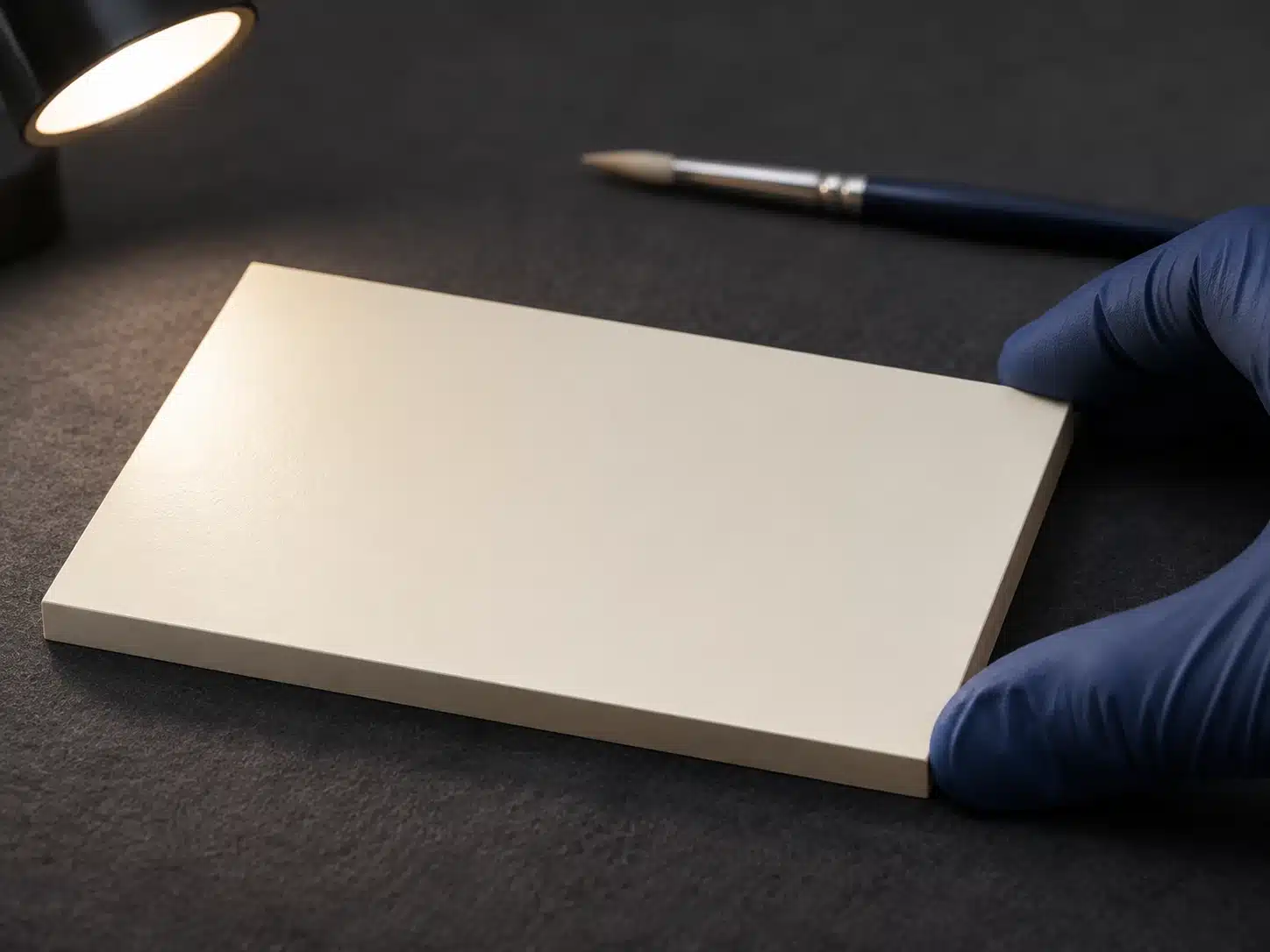
Appearance-review scene only; no sealant identity, cure, adhesion or movement result is shown.
7. Keep Joint Movement in the Coating Decision
Paint adhesion and movement compatibility are separate questions. A coating can initially cover a sealant while still being unsuitable for the deformation expected at the joint.
Sika’s construction-product guidance warns that rigid paint over a moving sealant or flexible adhesive can crack. A paintability statement therefore needs to be read with the actual coating and joint requirements.
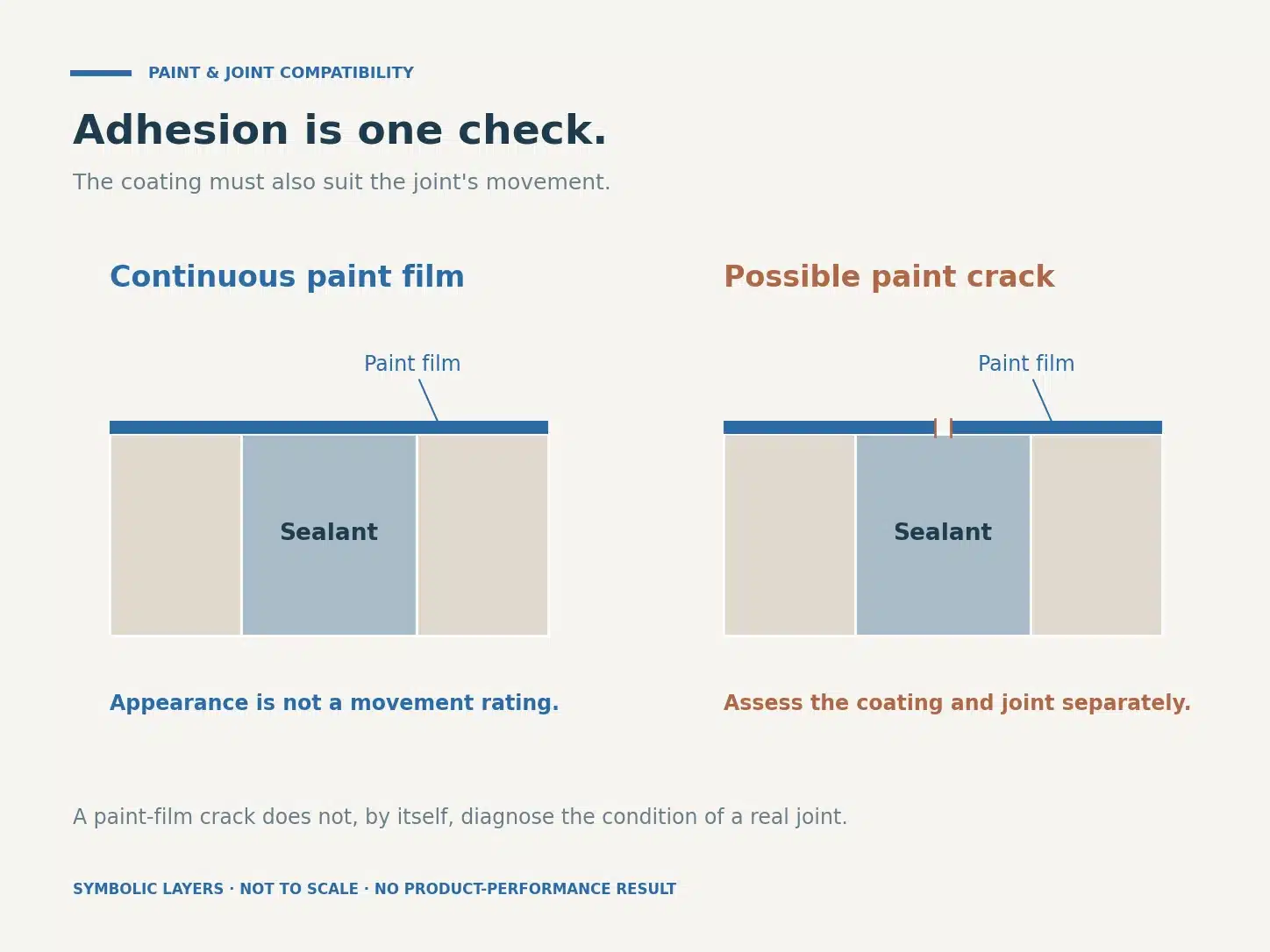
Conceptual layers only; no dimensions, movement rating, diagnosis or product-performance result is shown.
The schematic keeps the paint film and sealant distinct. It does not establish that a real joint remains sound because only paint damage is visible, or that every crack has the same cause.
For an active movement joint, obtain the required system assessment rather than relying on a stationary appearance sample. Keep the specified joint dimensions, backing and bonding arrangement in the review.
Where a compatible painted system cannot be established, discuss a suitable finish boundary or exposed sealant option with the responsible team. Preserve the functional joint requirements while resolving the decorative detail.
8. Plan the Decorator’s Handover Before Installation
Give the installer and decorator one agreed material list and sequence. Identify which areas receive sealant, which receive paint and where the finish is intended to stop.
KEDA’s joint sealing and weatherproofing guidance helps frame the sealing task. Keep the coating review attached to that task instead of treating paint approval as a replacement for joint suitability.
Record any specified tooling and cleanup products. An unrecorded finishing liquid or later cleaner can change what the coating contacts, even when the main sealant and paint remain unchanged.
For existing work, establish the condition and identity of retained material where possible. Do not apply a fresh cosmetic layer to hide a detached bead, unresolved leakage or a joint that needs repair.
If replacement is needed, agree the removal, preparation and revised joint detail for the actual assembly. Avoid assuming that one new paintable product can simply cover any old sealant.
Carry confirmed product changes through to the site record. A substitution made during purchasing should not reach the decorator with the old sample approval still attached.
9. Send a Specific Paintability Enquiry
When discussing an overpainted joint with KEDA, identify whether the paint will touch the sealant, mounting adhesive or only the adjoining substrate. Include photographs and a simple detail of the proposed finish boundary.
Provide the actual sealant or adhesive, full paint system, substrate finish, location, joint geometry and expected movement. Attach the relevant instructions and the intended work schedule.
If a trial has already been made, describe its preparation, timing, conditions and observed result. “The paint stayed on” leaves several important questions unanswered.
A useful outcome is a confirmed product combination and a defined process, with any remaining assessment clearly recorded. Decide the coated finish before production work so the joint’s function and the decorator’s expectations remain aligned.
Часто задаваемые вопросы
1. Can ordinary wall paint be applied over silicone sealant?
Do not assume it will adhere. Conventional silicone often presents paint-adhesion difficulties. Use the selected product’s overpainting instructions and confirm the actual coating system.
2. Does “multi-purpose adhesive and sealant” mean paintable?
No. Bonding, sealing and overpainting are separate requirements. Obtain confirmation for the supplied grade and proposed paint.
3. Can I paint as soon as the sealant skins over?
Only if that is the permitted stage for the actual combination. Skin formation is not a universal coating or full-cure criterion.
4. Does a good-looking stationary sample approve a moving joint?
No. It can inform the defined appearance review, while movement compatibility and any required system assessment remain separate.
5. Will a primer make any sealant paintable?
No universal primer solution is established. Confirm the sealant, primer and coating as a system; do not use primer to override a product restriction.