

You open a container of marble adhesive and see a glossy liquid pocket, a firmer surface layer or small lumps. The useful first question is what changed, and can the supplied product still meet its approved use requirements? Stirring everything together immediately makes that question harder to answer.
Photograph the untouched material, keep the container identifiable and compare the observation with the instructions for the actual grade. A product-specific instruction to stir before use is different from permission to break up a skin, blend hard fragments or add thinner.
This guide covers the unmixed base of polyester marble adhesive, before adding its matched hardener. It gives stone workshops and distributors a practical way to document an unusual container, arrange a meaningful review and prevent an unresolved material from entering production.
1. Identify the Product and the Stage of Use
Start with the full product name, color, container size and batch information. Establish whether this is an unopened delivery, a previously opened container or material already combined with hardener.
KEDA Knife Grade Polyester Marble Adhesive is a knife-grade system supplied with matched hardener for nonstructural stone fabrication and repair. Its instructions distinguish the original adhesive from the mixed working portion.
If hardener has already entered the container, report that immediately. Do not treat it as ordinary storage separation or return that mixture to the original stock. Check the applicable handling instructions before further action.
Keep the scope precise when discussing the wider polyester marble adhesive range. Guidance for an epoxy, a cartridge sealant or a different polyester grade does not establish the correct response for this container.
Write down when the condition was first noticed. “Present at first opening” and “noticed after several workshop uses” are different investigation starting points, even when the photographs look similar.
2. Describe the Observation Before Assigning a Cause
Use simple descriptions that another person can verify. State where the unusual material appears, whether the surface is intact and whether previous stirring has changed it.
| What you observe | Useful description | First action |
|---|---|---|
| Glossy liquid at the surface | Location and extent visible before disturbance | Photograph; check the grade’s preparation instructions |
| A firmer surface layer | Continuous layer, loose flakes or material attached to the rim | Hold for review before removing or blending it |
| Lumps or fragments | Where found and whether they remain during a permitted check | Record texture; keep the container out of production pending review |
| Generally thicker or softer paste | Whole-container behavior under recorded conditions | Compare equivalent conditions and the correct grade |
| Foreign particles or damaged packaging | Visible debris, closure condition or leakage | Record packaging and material together |
A photograph can show a liquid pocket. It cannot establish whether that liquid is a particular resin component, contamination or an acceptable condition for the supplied grade. Similarly, “lumpy” is an observation, not proof of one specific manufacturing or storage fault.
Keep the first photograph wide enough to identify the container and take a second close view of the surface. Use consistent lighting and avoid color filters. Include an external reference for scale where useful, without putting a dirty object into the material.

Fictional material observation, not a KEDA appearance standard or a diagnosis of separation.
3. Check Whether Stirring Is Actually Specified
Some polyester mastics have product-specific instructions addressing sedimentation or preparation before use. That is a reason to consult the right document, rather than declaring every separated container defective or every separated container usable.
For example, Tenax’s technical sheet for its Liquid colored polyester mastic discusses storage sedimentation and mixing before use. This concerns that named product. It does not establish an acceptable liquid layer, stirring method or release criterion for KEDA’s knife-grade adhesive.
Find the actual grade’s instructions and establish what condition the preparation step is intended to address. If they do not answer the observed issue, send the untouched photographs to the supplier before experimenting.
When stirring is permitted, use the specified method and clean equipment. Keep that base-preparation step separate from adding the matched hardener to a measured working portion. A base container should not become the mixing vessel for a curing trial.
Record the starting condition, the authorized preparation and the resulting condition. A uniform appearance afterward is useful information, but it is only one part of deciding whether the material is suitable for the intended job.
4. Distinguish Paste Consistency From Skin or Hard Fragments
A paste can resist movement at rest and feel different while being worked. AKEMI’s Marble Filler 1000 Thixo technical sheet describes a consistency change with stirring or spreading for that particular product. This illustrates why handling behavior needs a grade-specific reference.
A continuous surface layer or discrete firm fragments deserves its own description. Do not assume that every lump is ordinary paste structure, or that crushing it makes the original material condition irrelevant.
If a permitted check leaves persistent particles, report them. Record whether they were visible before preparation, appeared near the lid or rim, or were noticed only after dispensing. Keep observations separate from guesses about partial curing, dried material or contamination.
Do not press questionable fragments into a stone joint to see whether they disappear. Resolve the container’s status before using it on customer work. If supplier review calls for a separate texture sample, follow the sampling instructions and preserve its connection to the original container.
A comparison is strongest when it uses the same grade and color under equivalent conditions. A flowing adhesive, a different base color or an old photograph from another workshop is a weak acceptance reference for a knife-grade paste.
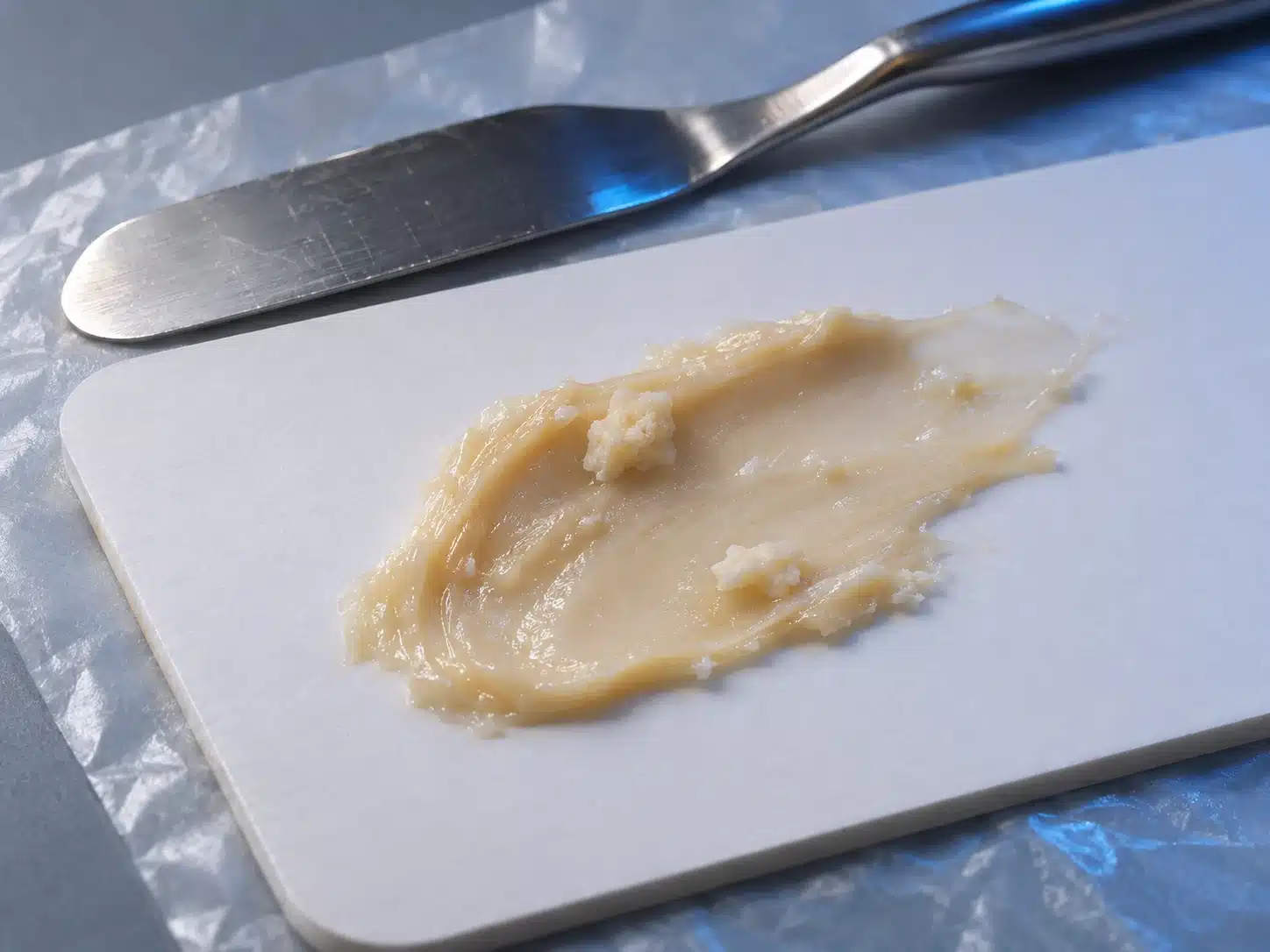
Editorial texture illustration. The particles do not identify a chemical cause or an acceptance limit.
5. Preserve Evidence With a Short Container Record
Create one record per questioned container. If several containers are involved, give each a temporary reference such as MC-01 and MC-02, and connect those references to the existing batch labels.
| Record field | What to capture |
|---|---|
| Product identity | Full grade, color, pack size and label photographs |
| Traceability | Batch or lot information and delivery reference |
| Opening history | First opening date, previous dispensing and any earlier preparation |
| Material condition | Untouched surface, location of unusual material and close photographs |
| Packaging | Lid, rim, seal condition, damage or leakage |
| Known exposure | Storage and transport information, with measured conditions where available |
| Contact history | Tools used, possible hardener contact and any additives already introduced |
| Review status | Hold, requested checks, responsible reviewer and final disposition |
Separate known facts from missing information. A warehouse described as “cool” is not a measured temperature history. Record the available evidence and mark gaps rather than filling them with assumptions.
Keep original labels readable and the closure associated with its container. Avoid transferring the entire contents into a plain bucket simply to obtain a better photograph. If a sample is requested, use the supplier’s instructions for the sample, packaging and identification.
The record should answer a practical question: can someone reviewing the issue tomorrow identify exactly which material was observed today?
6. Avoid Turning an Inspection Into an Uncontrolled Reformulation
Keep an unusual container unchanged until the required review is clear. Do not add workshop solvent, water, extra hardener or another adhesive to make the paste appear more familiar.
Some manufacturers specify particular modifiers for particular products. That does not authorize an improvised thinner for a different grade. Tool-cleaning guidance is also separate from permission to add a cleaner to the adhesive.
Do not skim off a liquid layer or remove a skin and assume that the remaining contents are automatically approved. Removing material changes what will be assessed and can erase useful evidence about the original condition.
Keep Stone Adhesive Color Paste in its proper role as an accessory for an approved compatible adhesive. It is not a remedy for an unresolved container condition and does not replace the matched hardener.
Read the actual labels and SDS before handling or sampling. Use their required protective equipment, ventilation and storage precautions. Keep an uncertain container within those requirements while it is held for review; an improvised inspection should not introduce heating or unnecessary exposure.
7. Make Any Follow-Up Trial Answer a Defined Question
A supplier may request additional observations or a controlled trial after reviewing the record. Agree the purpose first: checking base uniformity, processing behavior, finished appearance or another specified requirement.
For an authorized trial, record the adhesive and hardener identities, the prescribed dose and measurement basis, material conditions, working portion and relevant times. Keep the original container separate from the prepared trial mixture.
Use representative stone and the agreed preparation and joint detail. KEDA’s stone fabrication and repair guidance provides an application starting point; the actual trial needs to represent the customer’s intended work.
A cured spot does not, by itself, establish the bond quality of a fabricated edge. A normal-looking repair does not establish every required property. Assess the questions and acceptance criteria agreed for the job, including any performance verification that remains necessary.
Use an appropriate reference when comparison is requested, and keep the conditions consistent. Record unexpected observations as well as expected ones. Do not increase the hardener dose until a questioned material appears to cure on the desired schedule.
Retain the results with the container record. The trial supports a decision about the identified material and use; it should not become a general statement that all containers with a similar appearance are acceptable.
8. Give the Container a Clear Disposition
Keep “under review” visible to everyone who might dispense or dispatch the material. A container should not move back into available stock simply because its lid has been closed.
| Review position | Practical disposition | Record needed |
|---|---|---|
| Preparation and intended-use requirements are satisfied | Release only the identified material for the reviewed scope | Instructions used, completed checks and responsible decision |
| The observation or required information remains unresolved | Continue the hold and request the missing review | Open questions, container identity and next action |
| Material does not meet the applicable requirements | Exclude from production and arrange the agreed next step | Supplier decision, return or disposal instructions where relevant |
One affected container does not establish the condition of an entire shipment. Equally, one satisfactory container does not release every container in a lot. Agree any wider inspection or sampling scope with the responsible quality team and supplier.
Record who made the decision and when. If the question involves already dispatched material, preserve the customer and shipment references so the responsible team can assess the relevant scope.

Fictional traceability setup, not an actual held KEDA lot or prescribed storage arrangement.
9. Use the Findings to Improve the Next Order
For distributors and partners, connect repeat observations with the affected grade, color, container size, batch and handling history. This creates a useful discussion about supply and workshop practice without assigning a cause prematurely.
If a container remains open across many jobs, discuss pack selection alongside actual usage. A suitable pack size can make dispensing and stock rotation easier to manage. It does not replace the supplied closure, storage or shelf-life requirements.
Use the troubleshooting record with the opening date, storage history and a photo of the unmixed material.
Once the container is on hold, use the supplied safety data sheet to review handling and storage precautions. OSHA's guide to safety data sheet sections shows where to find that information; ask the supplier to assess the photographed change before returning the lot to use.
To request a KEDA material review, send the container record and original photographs. State whether the condition was present at first opening and whether hardener, pigment or other material has already been introduced.
Ask for a clear next step for that container: the applicable preparation, further information, an agreed evaluation or a disposition. A useful answer connects the observed condition to the actual product and intended application.
Frequently Asked Questions
1. Does a liquid layer mean the marble adhesive has expired?
A liquid layer alone does not establish expiry or usability. Check the actual grade, shelf-life information, storage history and permitted preparation before deciding.
2. Can I remove the skin and use the adhesive underneath?
Keep the container on hold for review first. Removing a layer does not establish that the remaining material meets its intended-use requirements.
3. Can I add solvent to smooth out lumps?
Do not improvise a thinner. Obtain the actual grade’s instructions; a solvent specified for cleaning tools is not automatically an adhesive additive.
4. What if the paste looks uniform after permitted stirring?
Record the result and complete the agreed review. Uniform appearance is an observation, not a substitute for any required processing or performance checks.
5. Should the whole shipment be rejected if one container is unusual?
Identify and hold the affected material, then agree the wider review scope. Use container and batch records to support the decision rather than extrapolating from one observation.


