
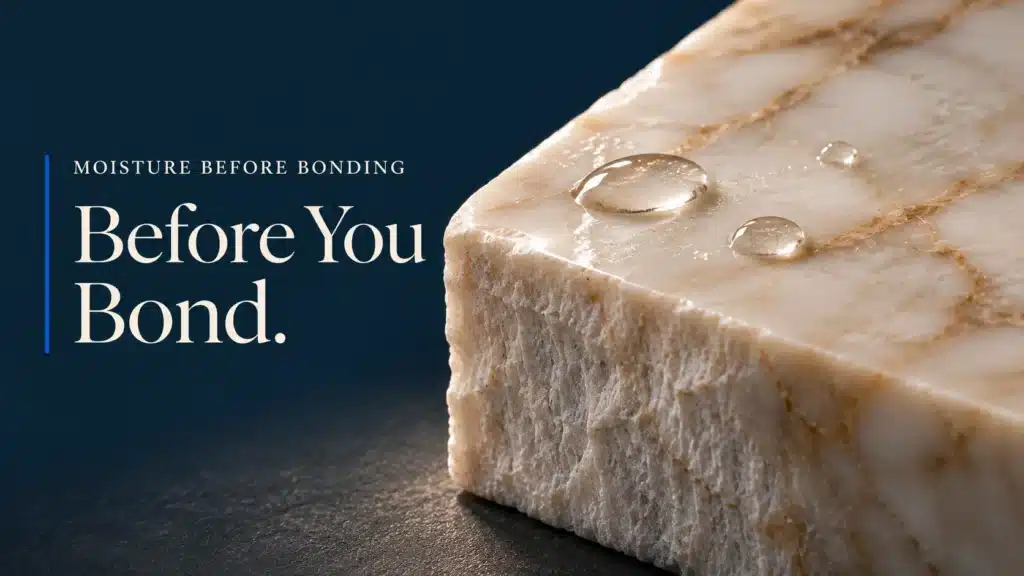
Do not apply marble adhesive to damp stone simply because the surface has been wiped or the product is described as water-resistant. First establish the moisture condition required by the actual adhesive, then check the bonding faces against that requirement.
KEDA’s current knife-grade polyester marble adhesive and specified structural epoxy instructions call for clean, dry bonding surfaces. Wet-cut pieces, washed edges, rain-exposed stock and cold stone brought into a humid workshop need a preparation check before mixing begins.
This guide explains what to inspect, how to interpret observations and when to hold the work for clarification. It covers moisture before bonding rather than a universal drying schedule or approval for wet-service installations.
1. Start with the Actual Adhesive’s Surface Requirement
Read the preparation instructions for the supplied grade. Identify whether they require a dry surface or explicitly permit another condition, together with any restrictions and preparation method. The word “epoxy” alone does not establish moisture tolerance.
For KEDA’s Knife Grade Polyester Marble Adhesive, prepare clean, dry contact faces and use the matched hardener according to the supplied instructions. Keep the surface-preparation decision separate from the hardener dose.
KEDA’s specified 2-Component Epoxy Structural Adhesive also requires dry bonding surfaces. Its confirmed ratio is A:B = 1:1 by weight. Keep the bonding surfaces dry as required by the product instructions.
Other products may have different instructions. Sika’s published Sikadur-31 CF Normal information, for example, permits a defined damp condition while excluding standing water. That permission belongs to that named product and its stated procedure, not to every structural epoxy or marble adhesive.
If the intended moisture condition is outside the supplied instructions, pause and request product-specific selection guidance before proceeding.
2. Identify Where the Water Came From
Record the last water-related operation and what happened afterward. Wet cutting, washing, outdoor storage and condensation create different preparation questions. Knowing the source helps identify where and when to inspect.
| Recent event | Areas to inspect | Question before bonding |
|---|---|---|
| Wet cutting or grinding | Sawn faces, recesses and cutting residue | Has the approved cleaning and drying process been completed? |
| Washing or rinsing | Actual contact faces, edges and supported areas | Are water or cleaner residues still present? |
| Rain or wet transport | Wrapped faces, contact points and sheltered pockets | Which surfaces were exposed or remained covered? |
| Cold-to-humid transfer | Stone surface and workshop conditions | Could condensation form before adhesive application? |
| Contact with a damp support or adjoining material | Both sides of the proposed joint | Is the complete interface within the product’s requirements? |
Inspect both bonding faces. A polished top can look dry while the intended edge or back still needs attention. Check accessible recesses and areas previously resting against packaging or supports.
Document uneven darkening, visible beads, a water film or wet residue as observations. Their absence does not establish a numerical moisture content, and a dark patch alone does not identify water as its cause.
Avoid combining the preparation decision with an appearance complaint. First identify the material and condition; then determine whether further assessment is needed.
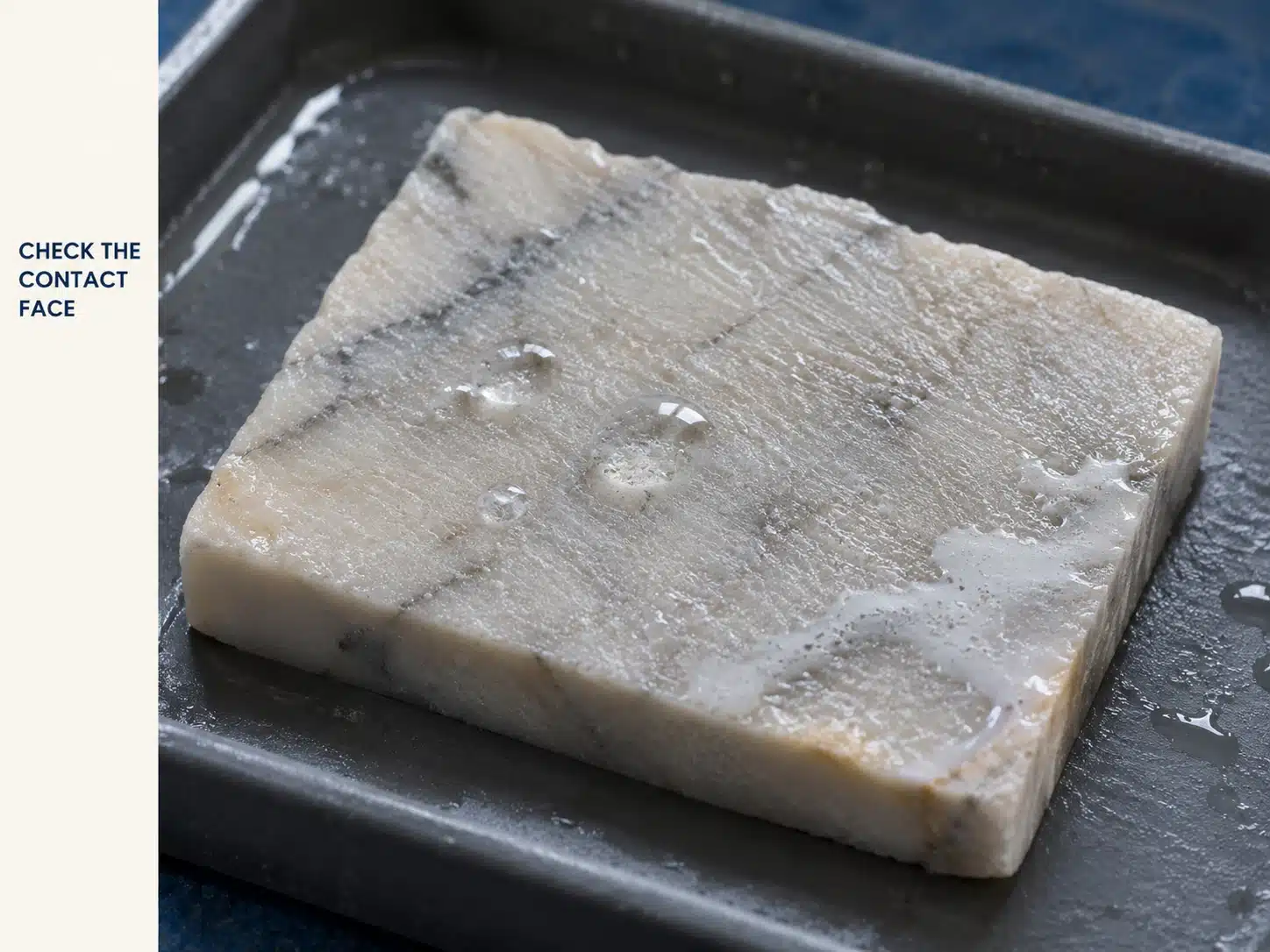
Editorial surface detail. Visible water and residue illustrate reasons to hold preparation; the image is not a moisture test.
3. Check the Contact Face After Wet Fabrication
After cutting or washing, complete the approved cleaning process and arrange the pieces so the relevant faces can be inspected. Keep them properly supported, protect edges and prevent new splash or contamination from reaching the preparation area.
Separate removal of loose water from confirmation of bonding readiness. Wiping can remove visible water, but it does not demonstrate that every relevant area meets the adhesive’s preparation requirement. The same distinction applies when the exposed surface has changed appearance during waiting.
Check for cutting slurry and cleaning residues as well as moisture. A dry residue is still something to address under the surface-preparation method. Drying does not replace the required cleaning operation.
Use KEDA’s stone fabrication and repair guidance to identify the actual task: a narrow joint, fabricated edge or local repair. Those details determine which faces and recesses need access before assembly.
For previously treated stone, identify the resin, backing or sealer where known. Do not assume that the appearance of an untreated offcut represents a coated bonding face. Keep the material history with the preparation record.
4. Check for Condensation When Conditions Change
Cold stone can develop surface condensation after entering warmer, moisture-laden air. The relevant comparison is between the stone surface temperature and the local air’s dew point, the temperature at which water vapor begins to condense.
Room temperature alone does not describe that comparison. Where condensation is a concern, obtain appropriate local air and surface observations using a method suitable for the job. Record where and when readings were taken, along with the instrument and measurement basis.
Check conditions close to the work area rather than substituting a weather forecast for workshop measurements. Reassess after relocation, a long delay or a meaningful environmental change.
Follow any dew-point margin or other environmental requirement stated for the actual product. Do not copy a numerical margin from an unrelated adhesive or coating into a KEDA instruction.
Plan the transfer and conditioning stage before mixing. If condensation is present or the required condition remains unresolved, hold the pieces for further preparation and review. Waiting until the adhesive is already mixed creates avoidable pressure to use an unready surface.

Equipment categories shown for editorial context, with no readings or calibrated setup. Select a suitable measurement method for the actual materials.
5. Understand What Each Check Establishes
Use observations and measurements for their stated purpose. A device reading needs its material setting, method and interpretation; a photograph needs its location and conditions. Neither should lose that context when entered into a workshop checklist.
| Check or record | What it helps establish | Limit to preserve |
|---|---|---|
| Visual inspection | Visible water, residue and areas needing attention | It does not quantify moisture inside the material |
| Recorded preparation history | Exposure, cleaning and time sequence | Elapsed time alone is not a release criterion |
| Local air and surface measurements | Conditions relevant to condensation | They do not directly measure stone moisture content |
| Material-appropriate moisture measurement | Information within the instrument or method’s stated scope | Its scale must not be reinterpreted as another measurement |
| Documented preparation release | Whether the agreed checks were completed | It covers the identified material and conditions |
Some meters use comparative scales for non-wood building materials. Tramex’s ME5 guidance explicitly distinguishes those readings from its wood moisture-content percentage. A comparative value is not automatically a stone moisture percentage.
Before using a meter for a stone decision, confirm its suitability, settings, reference procedure and limitations with the instrument supplier and responsible reviewer. Retain the device model, locations and reference information with the readings.
Where the adhesive or project specifies a numerical criterion, obtain the matching test method. Do not invent a universal acceptable percentage or use a wood-scale number as a substitute.
6. Organize Drying as Part of the Preparation Process
Plan a protected preparation area away from wet cutting and washing. Keep pieces supported and separated as the workshop’s handling method requires, with access to the faces that need inspection. Protect prepared surfaces from renewed water exposure and contamination.
Define who checks readiness before the pieces enter bonding. The instruction should identify the required surface condition, any applicable measurement method, the record to keep and the action when a requirement is not met.
Use a drying or conditioning procedure compatible with the stone, existing treatments and product instructions. Select any equipment through that process. A hot-air gun, open flame or improvised solvent wipe should not become an assumed shortcut because the production schedule is tight.
Avoid promising a fixed drying time for every slab. Relevant conditions include the preceding exposure, material, accessible faces, support arrangement and workshop environment. Base the release on the confirmed method and checks for the actual work.
If a prepared piece is washed again, splashed or moved into conditions that raise a condensation concern, reassess it before bonding. The earlier release describes an earlier condition.
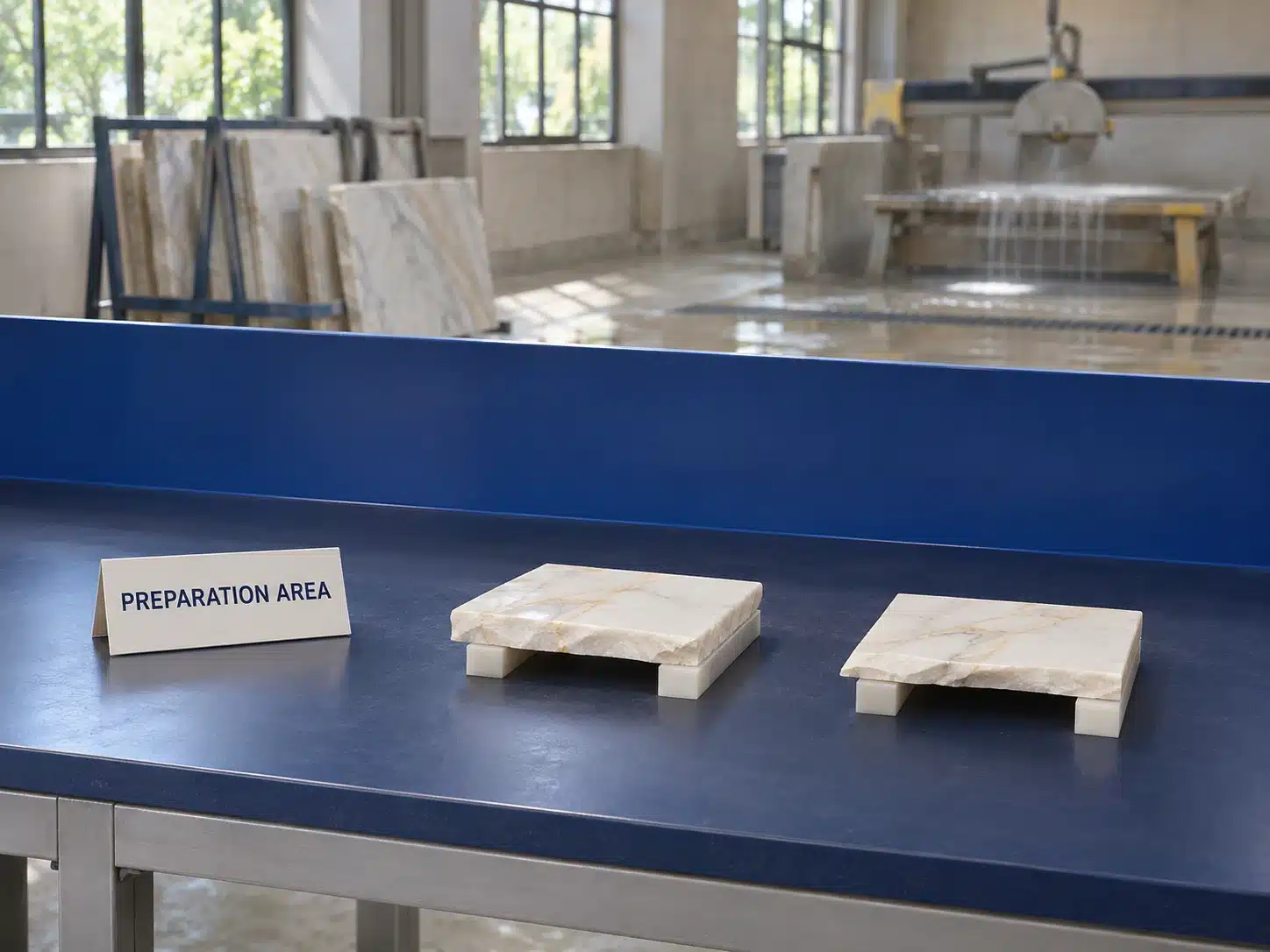
Conceptual separation of wet work and preparation. This scene is not a validated drying procedure or proof of bonding readiness.
7. Evaluate Representative Materials Within Permitted Conditions
Use actual production offcuts, known treatments and the proposed preparation process when evaluating the adhesive. Record the condition at application, not just how long the sample had been left on a bench.
KEDA’s guide to evaluating marble adhesive samples before a bulk order explains how to connect a trial to an accepted application. Include moisture preparation in that scope so the result remains relevant to routine work.
An appearance or processing trial should reproduce the permitted process. Deliberately bonding wet pieces outside the product instructions does not create permission for that use. A requested damp-substrate application needs a suitable product and an agreed assessment.
If bond evidence is required, define the specimen, preparation, method and acceptance criteria before testing. KEDA’s guide to testing stone adhesive bonds provides that planning context.
Keep the curing and observation records too. An acceptable-looking surface immediately after application answers a different question from the finished appearance or the performance of a bonded interface.
8. Use a Clear Hold-and-Recheck Decision
Make the preparation decision before mixing and keep it visible to the operator. The following table is a practical starting point for a workshop instruction, to be completed with actual product and job requirements.
| Finding before application | Immediate action | Record for the next check |
|---|---|---|
| Visible water, wet slurry or unresolved residue | Hold for approved preparation | Location, condition and preparation performed |
| Suspected condensation after transfer | Hold and assess local conditions | Air and surface observations, place and time |
| Unclear meter scale or missing criterion | Resolve interpretation before release | Instrument, setting, method and supplier question |
| Required checks completed satisfactorily | Release for the identified bonding step | Material, method, conditions and reviewer |
| Water exposure or relevant conditions changed after release | Recheck the affected work | Change, affected pieces and review outcome |
Keep a hold label specific: “awaiting preparation review” communicates the next action more clearly than “bad stone.” Identify which pieces it covers.
Do not adjust the hardener dose or add an unapproved ingredient to compensate for moisture. Surface readiness and component measurement remain separate requirements.
If bonding has already taken place under an unresolved condition, document the materials and process and seek review before machining or releasing the work. The next action should address the actual case rather than assuming extra waiting corrects it.
9. Ask the Supplier a Specific Moisture Question
Provide the adhesive grade, stone and treatments, both contact faces, recent water exposure and available observations. State the intended application and ask which condition and preparation method are permitted.
A useful request is: “These edges were wet-cut and then cleaned. What surface condition and verification method should we use before applying this supplied grade?” Include photographs and identify missing information.
Separate moisture at application from moisture during service. Permission to use a cured product in a particular exposure does not, by itself, authorize applying it to a wet surface. Similarly, a dry preparation requirement does not answer every question about later immersion or outdoor use.
For a specific requirement, contact KEDA before changing the material or preparation process. Keep the confirmed answer with the workshop instruction and the scope of the accepted application.
Frequently Asked Questions
1. Can I bond stone immediately after wet cutting?
Complete the approved cleaning and drying process first. Inspect the actual contact faces and meet the supplied adhesive’s requirements before mixing. No single waiting period covers every stone and workshop condition.
2. Is wiping the surface enough to make it ready?
Wiping removes visible water but does not establish the full preparation condition. Check the relevant faces, residues, exposure history and any required verification under the agreed method.
3. Can a moisture meter give the acceptable number for marble?
Only interpret a reading within its stated material and method scope. Comparative scales are not automatically moisture percentages. The acceptance criterion and appropriate measurement method must come from the actual product or job requirements.
4. Does water-resistant epoxy mean it can bond damp stone?
Check the named grade’s application instructions. Water resistance after curing and tolerance of moisture during application are different claims. KEDA’s specified structural epoxy currently calls for dry bonding faces.
5. Should I add more hardener when the stone is damp?
No. Follow the actual component instructions and resolve the surface condition separately. A changed hardener dose is not an approved moisture-preparation method.


