Fresh epoxy can bond to an existing epoxy surface in suitable, properly prepared systems. Before proceeding, confirm the old material, its condition and the new adhesive’s instructions. The word “epoxy” on both products does not establish compatibility or permission for the proposed repair.
Separate two situations: applying another layer within a documented recoat window, and bonding to an already cured surface. The preparation can differ. A surface that feels tacky is not, by itself, evidence that an approved recoat window remains open.
KEDA’s epoxy adhesive range provides a starting point for stone-bonding enquiries. Describe the existing resin layer as part of the bonding interface, rather than presenting the job only as stone-to-stone or stone-to-metal.
1. Identify the Existing Layer Before Adding Another
Establish whether the material is epoxy adhesive, a factory resin treatment, a coating or an unidentified previous repair. Appearance is insufficient to distinguish these reliably. Record its manufacturer and grade where available, together with application date and curing history.
Photograph the original surface and edges. Note contamination, cracks, detached areas or unevenly cured material without assuming a cause. Keep the original substrate in the record: a resin patch on stone creates a different interface from bare stone.
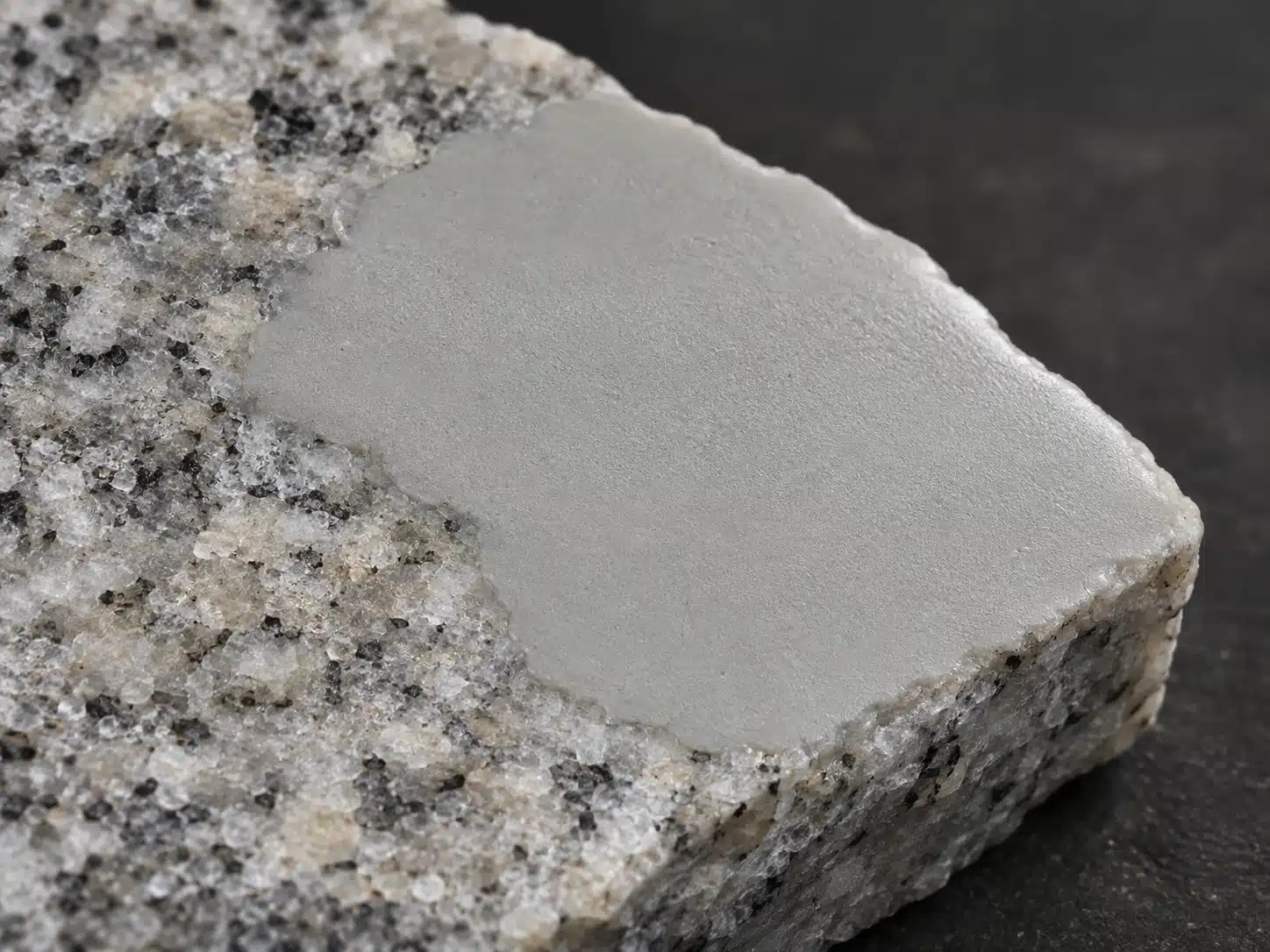
Illustrative surface detail. Texture and appearance establish neither resin identity nor satisfactory cure, preparation or adhesion.
| Existing condition | Establish first | Decision before applying fresh epoxy |
|---|---|---|
| Known product within a stated recoat period | Actual grade, elapsed time and conditions | Does its documented procedure permit the next application? |
| Known cured epoxy | Surface condition and required preparation | Is the proposed secondary bond permitted? |
| Waxy or otherwise suspect surface film | Product history and suitable assessment | What removal method applies to this residue? |
| Soft, loose or inconsistently cured material | Extent and underlying cause | What must be removed or corrected? |
| Unknown resin or previous repair | Material identity and representative sample | Can compatibility be established before work continues? |
If the original product cannot be identified, state that limitation explicitly. Do not relabel an unknown resin as epoxy because it is hard, gray or associated with a stone slab.
2. Distinguish a Recoat Window From a Cured-Surface Bond
Some epoxy systems permit another application while the previous material is partially cured. Within the specified conditions, the layers can link during curing. Once the material is cured, preparation for a secondary bond becomes important.
Obtain the actual product’s timing and surface criteria. A generic overnight interval or a thumbnail impression cannot replace them. Record application time, relevant temperature history and any interruptions rather than relying on the appearance at the moment work resumes.
Do not transfer a laminating-resin recoat window to a stone-installation paste. Different formulations and intended uses need their own instructions. If a stated window has been exceeded, ask for the required preparation; extra fresh adhesive does not reopen it.
For KEDA’s 2-Component Epoxy Structural Adhesive, request a decision on the actual existing layer and proposed assembly. Its stone-bonding scope does not automatically establish an epoxy-over-epoxy repair procedure.
Keep unexpected softness separate from planned partial cure. If the old mixture was incorrectly proportioned or incompletely mixed, covering it with correctly mixed epoxy does not establish a sound base. Resolve that condition before evaluating a new layer.
3. Review Both Interfaces in the Proposed Assembly
A fresh layer adds another interface; it does not remove the earlier one. Review the new epoxy’s attachment to the existing resin and the existing resin’s attachment to its original substrate. Also consider the condition of the material between those interfaces.
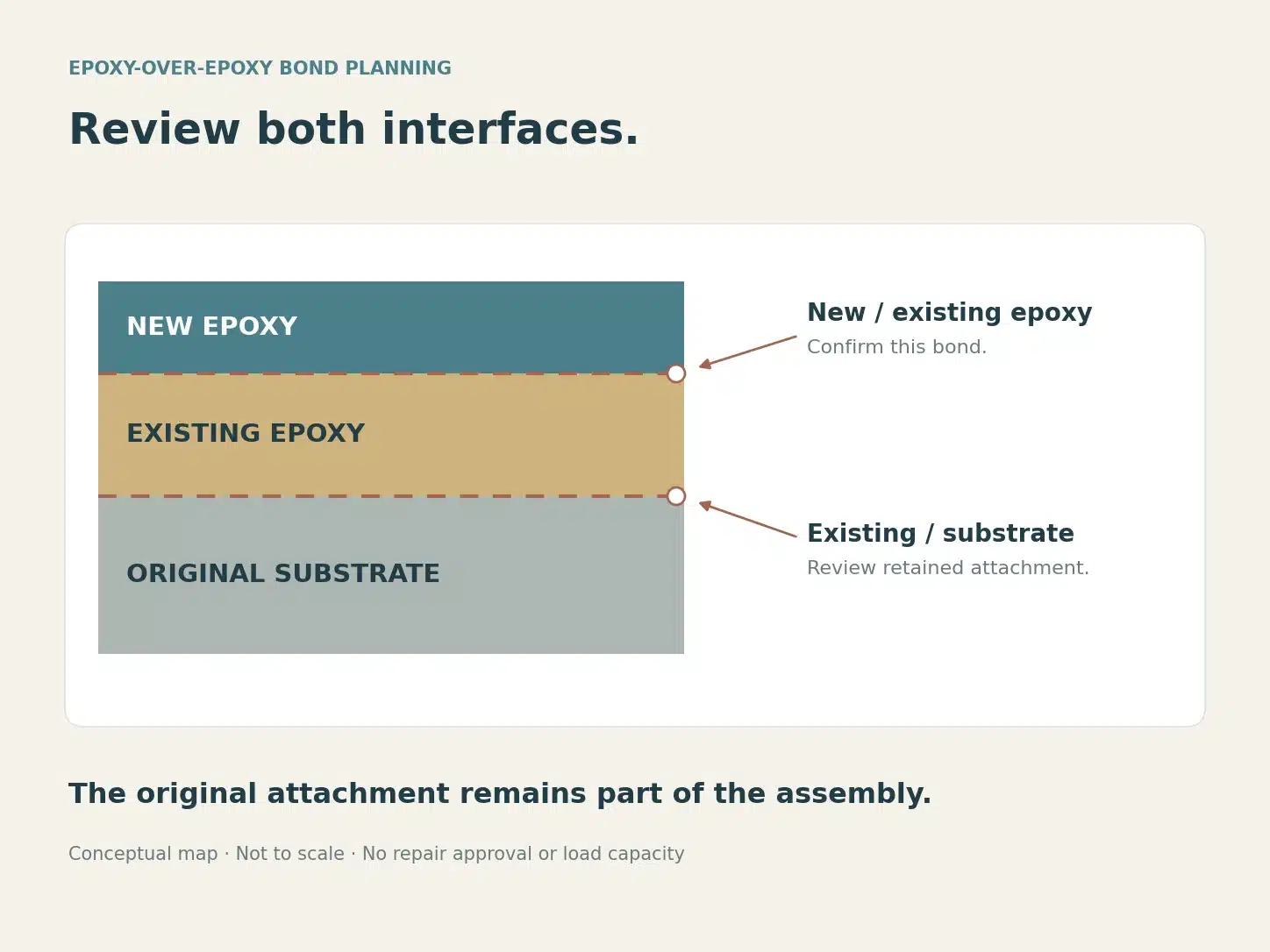
Conceptual interface map. Layer thicknesses are unscaled; the drawing shows no reinforcement detail, approved repair or load capacity.
Record where any existing separation occurs. A clean release from stone, a detached resin layer and a break within resin are different observations. Preserve representative loose material rather than removing all evidence before discussing the repair.
Do not repeatedly pull an installed panel to assess attachment. Agree an appropriate inspection or separate specimen method. Maintain the installation’s required supports while the condition and repair design are reviewed.
For interior slab enquiries, KEDA Low-Odor Epoxy Slab Adhesive follows its own product selection. Identify the slab backing and any existing resin separately. A compatible bare slab does not establish suitability for every backing or retained adhesive layer.
When the retained material’s attachment is uncertain, obtain a decision on removal or another repair approach. A visually neat new surface cannot substitute for that assessment.
4. Separate Surface Film From Defective Material
Some epoxy systems can develop amine blush, a water-soluble surface by-product that may interfere with later bonding. It is different from an incorrectly mixed or inadequately cured epoxy body. Not every visible film is blush, and a photograph cannot confirm the diagnosis.
Use the old product’s preparation guidance. Manufacturer procedures for blush commonly specify washing before sanding, with removal of dissolved residue and adequate drying. Solvent wiping is not an automatic substitute for that wash. Other contaminants may need a different compatible cleaning method.
Choose the method for the complete assembly. Water, cleaner or abrasive suitable for an independent resin coupon may affect neighboring stone, coatings or concealed materials. Confirm the sequence and protect the surrounding finishes before treating installed work.
Record whether the concern is restricted to the surface or extends into soft material. Do not sand unidentified uncured paste as though it were a sound cured layer. Obtain product-specific advice on removal and disposal where the material itself is defective.
If cleaning changes the visible condition, keep before-and-after observations with the same sample reference. The disappearance of a film is useful information, but it does not alone establish cure, compatibility or acceptance of the proposed bond.
5. Complete the Specified Preparation and Keep It Clean
For cured-surface bonding, preparation commonly includes appropriate cleaning, drying, abrasion and dust removal. Follow the approved sequence for the selected combination. Cleaning before abrasion can prevent contaminants being worked into the surface.
Do not copy a grit number or solvent from an unrelated epoxy guide. Confirm the required surface texture and permitted removal method, particularly near thin slabs, coatings or backing layers. The objective is the specified bonding surface, not maximum material removal.

Illustrative dust collection on a separate specimen. It demonstrates no complete preparation method or passing surface condition.
Inspect the accessible area after preparation. A uniformly dull appearance can help document coverage of the operation, but it does not prove that contamination is absent. Record the method rather than relying only on the finished photograph.
Protect the prepared surface from handling, workshop dust and later treatments. If it is left overnight or moved between work areas, record what happened and whether the actual procedure requires another check before bonding.
Release fabric can form part of some manufacturers’ surface-preparation systems. An arbitrary fabric or textured backing does not provide equivalent permission. If that method was used, identify the fabric and obtain the relevant compatibility and preparation instructions.
6. Make a Representative Secondary-Bond Trial
Prepare separate specimens representing the old layer, its substrate and the proposed new adhesive. Give the trial a reference such as EB-01. Match relevant cure history, surface treatments and geometry instead of applying fresh epoxy to an unrelated clean offcut.
Record what the trial represents and what remains unknown. If the existing installed resin cannot be reproduced or identified, document that limitation. A substitute sample should not be described as evidence for the unidentified original material.
| Trial field | Include | Keep distinct |
|---|---|---|
| Retained layer | Grade, age, cure history and original substrate | Known facts versus assumptions |
| Preparation | Cleaning, drying, abrasion and dust removal | Actual sequence versus appearance alone |
| New adhesive | Grade, matched components and measured quantities | Product identity versus general epoxy type |
| Assembly | Contact area, thickness, positioning and supports | Trial geometry versus installed geometry |
| Assessment | Method, stage, observations and acceptance basis | Qualitative observations versus measured performance |
Mix and place the new adhesive according to its own instructions. Preserve the specified component proportions and working period. Do not add extra hardener, solvent or water to alter its ability to cover the old layer.
Agree the assessment stage and method before opening or loading a specimen. Inspect both interfaces and the retained material where the method allows. Record the separation location without interpreting every tear as a passing result.
If preparation changes, identify a revised trial rather than silently replacing EB-01. Retain enough information to connect the result with the actual sequence used. A product recommendation is easier to review when changes are traceable.
Keep an unbonded prepared reference specimen alongside the trial. It lets the reviewer inspect the old surface without dismantling the bonded sample. Identify when each specimen was cleaned and abraded, and protect both from later handling so their histories remain comparable. Photograph the reference at the same recorded review stage.
7. Keep Repair Geometry and Support in the Decision
Confirm the complete proposed arrangement, including any change in contact area, adhesive thickness or component position. Fresh epoxy placed over an uneven old patch may create geometry different from the original installation design.
Do not use another layer merely to conceal a gap or restore a surface outline. Establish whether the retained layer is permitted and whether the new arrangement meets the application’s requirements. Any removal also needs review if it changes the original interface or damages the substrate.
KEDA’s stone cladding and panel installation solution provides the relevant route for discussing stone, backing, support material and fixings. Structural, overhead and cladding repairs require the appropriate product and project-specific design; this article supplies no repair approval.
Retain required mechanical fixings and temporary supports. Define who releases the assembly for handling and service, and on what evidence. Surface hardness is not a loading schedule, and a small trial is not permission to remove the installation’s supports.
Document the accepted repair area and subsequent operations. Keep finishing, loading and support removal as separate stages so cosmetic completion does not become an informal release decision.
8. Send a Complete Epoxy-Over-Epoxy Enquiry
Send a short description of the intended bond together with the old-layer information and EB-01 record. Explain why the existing material is being retained. Include photographs showing the full component and the proposed contact area.
| Enquiry item | Useful detail | Question it supports |
|---|---|---|
| Existing material | Manufacturer, grade, application and cure history | Is its condition and identity established? |
| Original interface | Stone, metal, coating or backing beneath it | Can the retained attachment be relied on? |
| Proposed application | New adhesive, geometry and exposure | Is this product combination and arrangement suitable? |
| Preparation | Actual process and relevant conditions | What confirmation or revision is needed? |
| Evidence | Trial record and agreed assessment results | What remains unresolved before proceeding? |
For distributor support, use the same information when customers ask whether two epoxies can be combined. KEDA’s distributors and partners page is a route for discussing the applications and documentation needed in your market. Avoid reducing an unidentified retained layer to a generic compatibility promise.
Send the product identities, interface sketch and trial observations through KEDA’s contact page. Ask for the confirmed combination, preparation and assessment requirements before using the proposed method more widely.
Frequently Asked Questions
1. Can fresh epoxy bond to cured epoxy?
It can in suitable, properly prepared systems. Confirm both materials, the retained layer’s condition and the intended application before selecting the preparation and trial method.
2. Does tackiness mean I can apply the next layer?
No. Use the actual product’s recoat criteria. Tackiness can have different causes and does not independently prove the correct cure stage or an open recoat window.
3. Is sanding enough to prepare old epoxy?
Not by itself. Assess contamination, surface films, cure and attachment first. Follow the specified cleaning, drying, abrasion and dust-removal sequence for the actual system.
4. Can a solvent wipe remove every epoxy surface film?
No universal solvent remedy applies. Amine blush and other contamination may require different methods. Identify the condition and use preparation compatible with the resin and surrounding materials.
5. Will a new layer strengthen poorly attached old epoxy?
Do not assume so. The original interface remains part of the assembly. Resolve weak attachment or defective material before relying on a new epoxy layer.