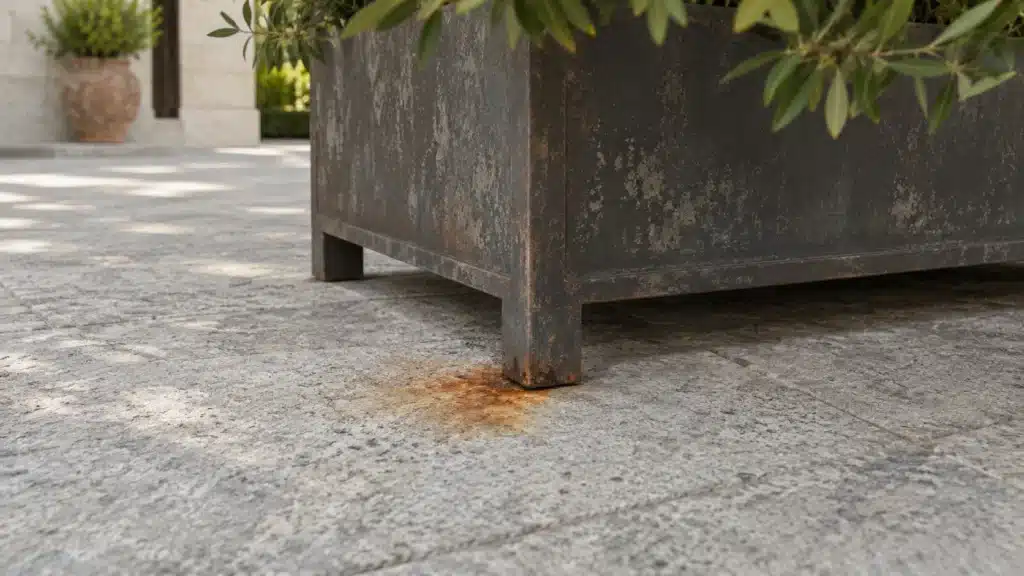
An orange-brown ring appears beneath a planter. A streak runs down stone below metalwork. Another mark returns after cleaning. These locations provide useful clues, but each needs a source check before a rust-removal product is selected.
Start with three questions: what is the stone, where could the discoloration come from, and which treatment is suitable for the complete surface? Then plan a controlled trial and assess both stain reduction and the condition of the finish.
This approach helps maintenance teams and distributors avoid two costly mistakes: treating every brown mark as rust and recommending a rust remover for stone that its instructions exclude.
1. Record the Pattern Before Cleaning It Away
Photograph the affected area and a wider view showing nearby objects, joints and possible runoff routes. Include what is above the mark, not only what sits beside it.
The Natural Stone Institute describes iron-related stains as commonly orange to brown and sometimes following the shape of a contacting object. That makes a furniture foot, container base or fitting worth investigating; the shape alone does not confirm the stain’s chemistry.
| Visible pattern | Useful source question | What to record |
|---|---|---|
| Ring or localized mark at a contact point | What object stood here, and what contacted the stone? | Object material, contact face and duration |
| Streak below metalwork | Can runoff reach the affected surface? | Fitting above, flow route and weather history |
| Repeated spots around one area | Is there a shared exposure or maintenance activity? | Nearby work, irrigation, moved objects and cleaning history |
| Discoloration returning in the same location | Has the original source or moisture condition continued? | Timing of recurrence and changes since treatment |
| Brown mark without an identified source | Could another deposit or treatment be involved? | Stone, previous products and surrounding activities |
Keep observations separate from conclusions. “Orange mark beneath a steel stand” is a useful record even when “rust caused by this stand” has not yet been established.
Da KEDA stone care range separates cleaning, targeted stain treatment, protection and finishing. Choose the task first rather than starting with the strongest-sounding product name.

Editorial discoloration example; color alone does not identify the cause or depth.
2. Identify the Stone and Its Surface System
Obtain the stone specification where possible. Record the finish and any resin treatment, coating, sealer or previous restoration. Include grout, adjacent metal, planting and other materials that a treatment or its residues could contact.
A honed finish does not change the underlying stone’s sensitivity to an unsuitable cleaner. Likewise, a trade name or a photograph is not enough to establish that an entire installation is chemically compatible.
The Natural Stone Institute explains that calcium-carbonate-rich stone is sensitive to acidic solutions. It also cautions that siliceous stone can contain acid-sensitive minerals. Material selection therefore needs more detail than a broad marble-versus-granite assumption.
KEDA SC400 Removedor de ferrugem e manchas para pedra is presented for compatible acid-resistant stone. Do not use it on marble, limestone, travertine or other acid-sensitive surfaces. Obtain a different, specifically approved treatment for those materials.
For a stone sold as granite, confirm the exact material, finish and treatments before selecting a product. The name does not approve the resin, coating, grout or nearby finishes that may also be exposed.
If the stone identity is uncertain, pause chemical selection and obtain the missing information. Do not use an acid spot test on the installed finish as an informal identification method. A trial must follow a permitted material selection, not override an explicit exclusion.
3. Investigate the Source Beyond the Visible Mark
Inspect accessible contact objects and nearby metalwork without disturbing the installation. Look at container feet, furniture bases, tools left on the surface and the route water could take toward the stone.
Ask when the mark first appeared. Was metalwork installed recently? Was an object moved? Did staining follow rainfall, irrigation, construction work or a change in cleaning practice? Record the sequence even when precise dates are unavailable.
Separate removal of the visible stain from correction of the source. A treatment applied to stone does not repair corroding metal or stop contaminated water reaching the same area again.
Assign source correction to the appropriate maintenance or installation team. The plan may involve the contacting object, a fitting or the water route, but it should suit the actual materials and installation rather than an improvised coating or barrier.
If the suspected source is concealed or embedded, obtain specialist assessment before altering the stone or fitting. Do not loosen facade components or remove anchors to investigate a surface stain.
Preserve the initial photographs before any object is moved or source work begins. Photograph the changed arrangement afterward so a later recurrence can be compared with what actually changed.
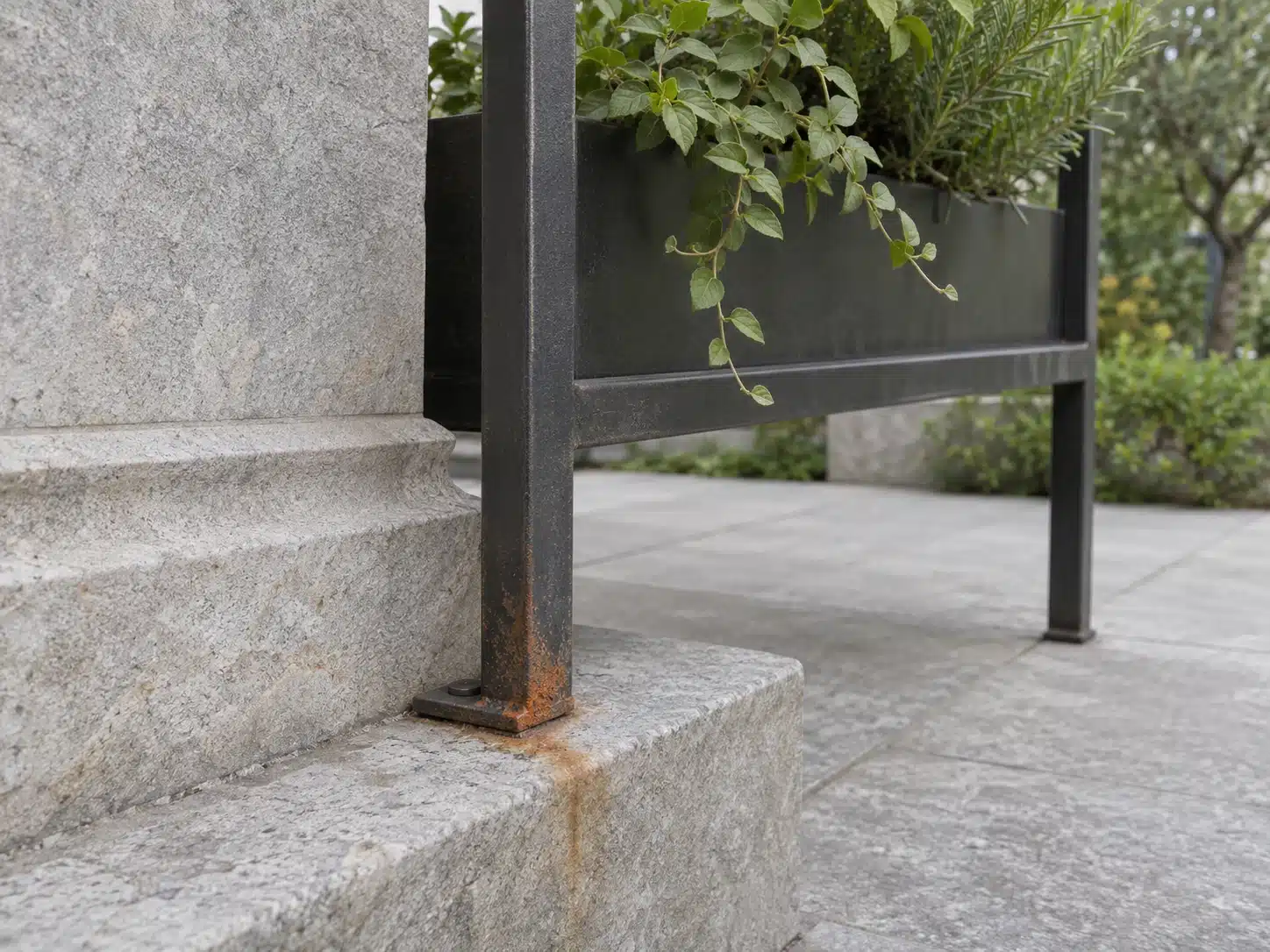
Fictional maintenance scene showing a route to investigate, not proof of causation.
The Natural Stone Institute's guide to metal stains describes how iron staining can copy the shape of a metal object. Compare the stain with nearby fixtures, hardware and run-off paths before choosing a treatment.
4. Match the Product Role to the Identified Problem
General grime, a targeted rust stain and an etched finish are different maintenance tasks. Several can occur in the same area, so identify which result each proposed operation is meant to deliver.
| Task | Product role to discuss | Keep separate |
|---|---|---|
| Surface grease or accumulated grime | Compatible cleaner/degreaser | Targeted rust treatment and absorbed stains |
| Identified rust-related discoloration | Rust-removal method approved for the stone and finish | Corrosion repair and continuing contamination |
| Protection of compatible absorbent stone | Separately selected penetrating treatment | Removal of an existing stain |
| Dullness, etching or damaged texture | Finish assessment or restoration | Deposit removal alone |
KEDA SC300 – Limpador e Desengraxante para Pedras de Alto Desempenho addresses compatible surface oil films, grease and built-up grime. Its role does not make it a substitute for a targeted rust-treatment assessment.
KEDA SC100 Selante Penetrante para Pedra is a protection option for compatible absorbent stone. Selecting a sealer is a separate decision from cleaning a stain or correcting its source.
If a project requires more than one operation, confirm the complete sequence, preparation between stages and compatibility of the products. Do not mix them or assume the product numbers describe a mandatory treatment system.
Keep metal maintenance separate too. A remover selected for staining on stone is not automatically a product for treating the metal object itself. Protect fittings and obtain the correct method for their materials.
5. Prepare a Representative Trial With Clear Limits
Choose a representative spare piece or an approved inconspicuous area. It should reflect the actual stone, finish, existing treatment and staining condition as closely as practicable.
Before applying anything, obtain the selected product’s current instructions and SDS. Confirm the surface condition, concentration where applicable, tool, contact period, treatment boundary, removal method and required final assessment stage.
Record the initial appearance under useful lighting. Include a close view of the mark and a wider view of the surrounding finish. Identify an adjacent reference that will remain untreated during the trial, where the agreed method permits.
Plan containment and access. Protect neighboring materials and arrange collection of treatment residues so they are not spread across joints, metalwork, planting or other finishes. Use the handling and protective equipment specified for the actual product.
Apply only the approved method. Do not extend contact overnight, cover the product or make a homemade poultice unless the supplied procedure specifically permits it for that application.
The Natural Stone Institute identifies poulticing and professional assessment as possible routes for difficult stains. That does not make a generic poultice recipe the instructions for every rust remover or stone.
Complete the prescribed cleanup and let the surface reach the required assessment condition. A result seen while the area remains wet is not a complete record of its final appearance.

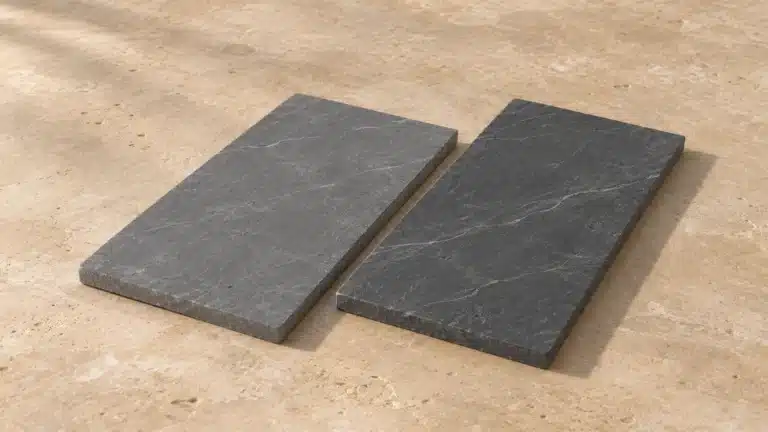
Trial-planning props, not an approved chemical recipe, tool specification or result.
6. Assess the Finish as Well as the Stain
Compare the treated area with its original record and the agreed reference. Review remaining discoloration, color change, gloss, texture, residue and the treatment boundary.
Use consistent lighting and viewpoint for photographs. Distinguish a weaker stain from an apparent change caused by moisture or reflection. Note the assessment stage and any remaining uncertainty.
If discoloration reduces but a dull patch appears, record both outcomes. Stain reduction does not establish that the original finish has been preserved. The Natural Stone Institute treats acid etching as a surface-finish issue, separate from the presence of a stain.
Where the finish changes, stop further treatment and obtain the next assessment. Increasing concentration, contact time or scrubbing pressure is not a general response to an incomplete result.
For a persistent mark, review whether the material, source and depth were correctly understood. Deep staining may need specialist work, and some marks may remain. The Natural Stone Institute specifically cautions that deeply seated rust stains can be difficult to remove completely.
Agree the scope of any follow-up before treating a wider area. A successful small trial supports the tested configuration; it does not automatically approve different stones, coatings or adjacent materials elsewhere on the project.
7. Keep a Record That Separates Treatment From Recurrence
Use a location reference such as RS-01 to connect the photographs, source inspection and trial. Keep the same reference when the area is checked again.
| Record group | Information to retain |
|---|---|
| Surface identity | Stone specification, finish, previous treatments and adjoining materials |
| Original condition | Location, pattern, extent and photographs before intervention |
| Source review | Contact objects, accessible metalwork, water routes and unresolved questions |
| Treatment method | Actual product, approved application details and cleanup |
| Final assessment | Dry or specified-stage appearance, stain change and finish condition |
| Source correction | Work completed, responsible team and what changed |
| Follow-up | Date, conditions, recurrence location and next decision |
Record the difference between a stain that remained after treatment and one that returned after an initially improved result. Those histories can lead to different investigation questions.
For recurring marks, compare the new pattern with the original source and water route. Include any new objects, maintenance work or changes in exposure. Repeating the same cleaner without reviewing those changes can conceal the information needed to solve the problem.
Avoid promising a permanent result from the first cleaned sample. Define what the treatment addressed and what remains dependent on source correction, material condition or further assessment.
For distributors, this record is also a useful customer-enquiry form. It connects the requested remover to an actual surface and history instead of a photograph labeled only “brown stain.”
8. Plan Aftercare and the Supplier Enquiry
Use KEDA’s stone protection and maintenance guidance to organize any later cleaning, protection or finishing discussion around the assessed surface.
Do not apply a sealer or enhancer simply to hide a remaining mark or bypass a finish problem. Confirm the preparation and compatibility required for any proposed follow-on treatment after stain work is complete.
Keep routine care distinct from specialist stain removal. Record the approved maintenance products and handling of objects that contact the surface. Share the source-correction plan with the people responsible for the area.
Once the rust source is addressed, use the stone care selection guide for any separate protection or finish request.
When discussing stone rust stains with KEDA, send the stone specification, finish, photographs, approximate affected area and previous treatment history. Include nearby metalwork, water routes and whether the mark remained or returned.
Ask for the next decision that fits that case: additional identification, a permitted product, a representative trial or specialist assessment. A clear enquiry helps prevent a targeted rust remover being recommended for an excluded material or an unrelated deposit.
Perguntas frequentes
1. Can SC400 be used on marble rust stains?
No. Its stated scope excludes marble, limestone, travertine and other acid-sensitive materials. Select a different treatment specifically approved for the actual surface.
2. Is a rust remover automatically suitable for granite?
No. Confirm the specific stone, finish, resin or coating and adjacent materials against the selected product’s instructions.
3. Does every orange-brown mark on stone mean rust?
No. Color and pattern are clues. Review the source, material and treatment history before selecting a chemical method.
4. Should I leave the remover longer if the stain remains?
Use only the prescribed contact period. An incomplete result calls for reassessment, not an improvised stronger or longer treatment.
5. Will sealing the stone stop the stain from returning?
A sealer does not repair a corroding fitting or stop contaminated runoff. Correct the source and assess any protection treatment separately.